


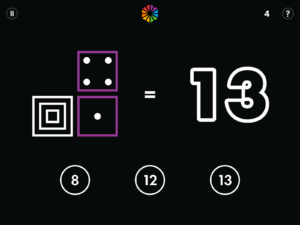
Tile Farm Academy is a supplemental daily math routine designed to strengthen number sense, fluency, reasoning, visual modeling, mathematical communication, algebra readiness, and creative problem-solving alongside the curriculum schools already use.
The alignment below shows how Tile Farm supports key Grades 6–8 mathematical domains connected to the Common Core State Standards. Tile Farm is not intended to replace a full core curriculum. Instead, it gives students repeated, joyful opportunities to strengthen the foundational ideas, flexible strategies, and habits of mind that make middle school mathematics more meaningful, accessible, and lasting.
By middle school, many students have already developed a complicated relationship with math. Some students see mathematics as stressful, abstract, or disconnected from how they think. Tile Farm helps students rebuild confidence while strengthening the number sense, fluency, reasoning, and algebraic thinking they need for grade-level mathematics, high school math, and more advanced learning.
Ratios and Proportional Relationships
Tile Farm Academy supports proportional reasoning by helping students connect multiplication, division, fractions, decimals, percentages, rates, scaling, and equivalent relationships. Through Daily Digits, Tile Talk, and Number Portraits, students encounter ratios and proportional situations as meaningful relationships that can be represented visually, numerically, verbally, and symbolically. Tile Farm helps students develop the flexible number sense needed to reason about proportional relationships with confidence.
Grade 6
6.RP.A.1
Understand the concept of a ratio and use ratio language to describe a ratio relationship between two quantities.
6.RP.A.2
Understand the concept of a unit rate associated with a ratio.
6.RP.A.3.a
Make tables of equivalent ratios, find missing values, and plot pairs of values.
6.RP.A.3.c
Find a percent of a quantity as a rate per 100 and solve problems involving parts, wholes, and percents.
6.RP.A.3.d
Use ratio reasoning to convert measurement units.
Grade 7
7.RP.A.1
Compute unit rates associated with ratios of fractions.
7.RP.A.2
Recognize and represent proportional relationships between quantities.
7.RP.A.2.a
Decide whether two quantities are in a proportional relationship.
7.RP.A.2.b
Identify the constant of proportionality in tables, graphs, equations, diagrams, and verbal descriptions.
7.RP.A.2.c
Represent proportional relationships by equations.
7.RP.A.3
Use proportional relationships to solve multi-step ratio and percent problems.
The Number System
Tile Farm supports number system understanding by helping students reason flexibly with whole numbers, fractions, decimals, percentages, positive and negative numbers, and rational numbers. Daily Digits helps students maintain fluency with core number concepts while extending their understanding to increasingly abstract middle school topics. Tile Talk and Number Portraits give students opportunities to represent, explain, compare, and justify numerical relationships in multiple ways.
Grade 6
6.NS.A.1
Interpret and compute quotients of fractions and solve word problems involving division of fractions by fractions.
6.NS.B.2
Fluently divide multi-digit numbers.
6.NS.B.4
Find greatest common factors and least common multiples, and use the distributive property to express sums.
6.NS.C.5
Understand positive and negative numbers as describing quantities in opposite directions or values.
6.NS.C.6
Understand a rational number as a point on the number line.
6.NS.C.6.a
Recognize opposite signs of numbers as indicating locations on opposite sides of 0 on the number line.
6.NS.C.6.b
Understand signs of numbers in ordered pairs as indicating locations in quadrants of the coordinate plane.
6.NS.C.6.c
Find and position integers and other rational numbers on horizontal and vertical number line diagrams and coordinate planes.
6.NS.C.7
Understand ordering and absolute value of rational numbers.
6.NS.C.7.a
Interpret statements of inequality as statements about relative position on a number line.
6.NS.C.7.b
Write, interpret, and explain statements of order for rational numbers.
Grade 7
7.NS.A.1
Apply and extend previous understandings of addition and subtraction to add and subtract rational numbers.
7.NS.A.1.a
Describe situations in which opposite quantities combine to make 0.
7.NS.A.1.b
Understand addition of rational numbers on a number line.
7.NS.A.1.c
Understand subtraction of rational numbers as adding the additive inverse.
7.NS.A.1.d
Apply properties of operations as strategies to add and subtract rational numbers.
7.NS.A.2
Apply and extend previous understandings of multiplication and division and of fractions to multiply and divide rational numbers.
7.NS.A.2.a
Understand rules for multiplying signed numbers.
7.NS.A.2.b
Understand division of integers and rational numbers.
7.NS.A.2.c
Apply properties of operations as strategies to multiply and divide rational numbers.
Expressions and Equations
Tile Farm Academy supports expressions and equations by helping students understand symbols as meaningful representations of numerical relationships. Students practice evaluating expressions, reasoning about equivalence, using properties of operations, solving problems with unknown values, and making connections between arithmetic and algebra. Tile Farm helps students see algebra not as a separate subject, but as a natural extension of the structure and relationships they have been building through number sense and visual reasoning.
Grade 6
6.EE.A.1
Write and evaluate numerical expressions involving whole-number exponents.
6.EE.A.2
Write, read, and evaluate expressions in which letters stand for numbers.
6.EE.A.2.a
Write expressions that record operations with numbers and letters.
6.EE.A.2.b
Identify parts of an expression using mathematical terms.
6.EE.A.2.c
Evaluate expressions at specific values of their variables.
6.EE.A.3
Apply properties of operations to generate equivalent expressions.
6.EE.A.4
Identify when two expressions are equivalent.
6.EE.B.5
Understand solving an equation or inequality as answering which values make it true.
6.EE.B.6
Use variables to represent numbers and write expressions when solving problems.
6.EE.B.7
Solve real-world and mathematical problems by writing and solving equations.
6.EE.C.9
Use variables to represent two quantities that change in relationship to one another.
Grade 7
7.EE.A.1
Apply properties of operations as strategies to add, subtract, factor, and expand linear expressions.
7.EE.A.2
Understand that rewriting an expression in different forms can reveal different information about a problem.
7.EE.B.3
Solve multi-step real-world and mathematical problems using positive and negative rational numbers.
7.EE.B.4
Use variables to represent quantities in real-world or mathematical problems and construct equations and inequalities to solve problems.
7.EE.B.4.a
Solve word problems leading to equations of the form px + q = r and p(x + q) = r.
Grade 8
8.EE.A.1
Know and apply the properties of integer exponents.
8.EE.A.2
Use square root and cube root symbols to represent solutions to equations.
8.EE.A.3
Use numbers expressed in scientific notation to estimate very large or very small quantities.
8.EE.A.4
Perform operations with numbers expressed in scientific notation.
8.EE.C.7
Solve linear equations in one variable.
8.EE.C.7.a
Give examples of linear equations in one variable with one solution, infinitely many solutions, or no solutions.
8.EE.C.7.b
Solve linear equations with rational number coefficients.
Functions
Tile Farm supports early function thinking by helping students recognize patterns, relationships, inputs and outputs, and rules that connect quantities. While Tile Farm’s strongest middle school focus is number sense and algebra readiness, many activities support the habits of mind students need to understand functions: noticing regularity, identifying structure, representing relationships, and explaining how one quantity changes in relation to another.
Grade 8
8.F.A.1
Understand that a function is a rule that assigns to each input exactly one output.
8.F.A.2
Compare properties of two functions represented in different ways.
8.F.B.4
Construct a function to model a linear relationship between two quantities.
Geometry
Tile Farm is inherently geometrical and supports geometry through visual composition and decomposition, spatial reasoning, symmetry, patterning, transformation, measurement, coordinate reasoning, and development of geometric vocabulary. In Number Portraits especially, students use shapes and digital manipulatives to build, arrange, transform, and describe mathematical ideas. Students learn that shapes can be combined, broken apart, compared, rotated, reflected, repeated, scaled, classified, and used as tools for representing number relationships.
Grade 6
6.G.A.1
Find the area of right triangles, other triangles, special quadrilaterals, and polygons by composing and decomposing shapes.
Grade 7
7.G.A.1
Solve problems involving scale drawings of geometric figures.
7.G.A.2
Draw geometric shapes with given conditions.
7.G.B.6
Solve real-world and mathematical problems involving area, volume, and surface area.
Grade 8
8.G.A.1
Verify experimentally the properties of rotations, reflections, and translations.
8.G.A.2
Understand that a two-dimensional figure is congruent to another if the second can be obtained from the first by rotations, reflections, and translations.
8.G.A.4
Understand that a two-dimensional figure is similar to another if the second can be obtained by rotations, reflections, translations, and dilations.
8.G.A.5
Use informal arguments to establish facts about angles.
Statistics and Probability
Tile Farm supports statistics and probability through mathematical discussion, data interpretation, visual representation, comparison, pattern recognition, and reasoning about quantities in context. While Tile Farm’s deepest emphasis is number sense, fluency, and algebra readiness, many activities invite students to interpret visual information, organize mathematical observations, notice relationships, and explain patterns in data-like situations.
Grade 6
6.SP.A.1
Recognize a statistical question as one that anticipates variability in data.
6.SP.A.2
Understand that a set of data has a distribution that can be described by its center, spread, and overall shape.
6.SP.A.3
Recognize that a measure of center summarizes all values with a single number, while a measure of variation describes how values vary.
6.SP.B.4
Display numerical data in plots on a number line, including dot plots, histograms, and box plots.
6.SP.B.5
Summarize numerical data sets in relation to their context.
Grade 7
7.SP.A.1
Understand that statistics can be used to gain information about a population by examining a sample.
7.SP.A.2
Use data from a random sample to draw inferences about a population.
Grade 8
8.SP.A.2
Know that straight lines are widely used to model relationships between two quantitative variables.
Standards for Mathematical Practice in Grades 6–8
Tile Farm also supports the Standards for Mathematical Practice in Grades 6–8 by giving students frequent opportunities to reason, model, explain, create, revise, and look for structure in mathematical situations.
MP1. Make sense of problems and persevere in solving them
Students work through visual and numerical challenges that encourage persistence, strategy testing, revision, and problem-solving stamina, especially as mathematics becomes more abstract.
MP2. Reason abstractly and quantitatively
Students connect quantities, symbols, diagrams, visual models, expressions, equations, and explanations as they move between concrete, visual, numerical, and abstract representations.
MP3. Construct viable arguments and critique the reasoning of others
Tile Talk and classroom discussion invite students to explain strategies, compare approaches, analyze mistakes, justify conclusions, and respond to the reasoning of classmates.
MP4. Model with mathematics
Number Portraits and visual routines help students represent mathematical relationships using quantities, shapes, patterns, diagrams, expressions, equations, and digital manipulatives.
MP5. Use appropriate tools strategically
Students choose from different visual tools and representations, learning that different tools can reveal different mathematical relationships and support different kinds of reasoning.
MP6. Attend to precision
Students calculate carefully, use mathematical vocabulary, label representations, and communicate strategies, relationships, expressions, and visual designs with increasing clarity and accuracy.
MP7. Look for and make use of structure
Tile Farm’s visual environments help students notice structure in number systems, factors, multiples, proportional relationships, expressions, equations, functions, geometry, symmetry, transformations, and patterns.
MP8. Look for and express regularity in repeated reasoning
Students reuse familiar structures and strategies across activities, helping them move from solving individual problems toward recognizing broader mathematical patterns, generalizations, and algebraic relationships.
Summary
Across Grades 6–8, Tile Farm Academy supports the development of strong middle school mathematical foundations: number sense, rational number reasoning, proportional relationships, expressions, equations, functions, geometry, statistics, mathematical modeling, explanation, and algebra readiness.
Most importantly, Tile Farm helps students experience mathematics as something joyful, creative, and deeply understandable—something they can see, build, discuss, and explore. Through playful daily routines, visual problem-solving, math talk, and creative work like Number Portraits, students develop not only standards-based skills, but also the confidence, curiosity, perseverance, and flexible thinking they need for success in middle school, high school, and beyond.