


Building the Mathematical Thinking Students Need to Succeed

Tile Farm Academy is a supplemental K–8 mathematics program designed to strengthen number sense, fluency, reasoning, confidence, and problem-solving perseverance, while changing the way students and teachers feel about math.
Rather than replacing grade-level instruction, Tile Farm Academy develops the mathematical understanding students need to succeed within any curriculum. Students learn to recognize numerical relationships, choose flexible strategies, explain their reasoning, identify patterns, persevere through challenges, and approach unfamiliar problems with confidence.
How It Is Used: A Supplement to Any Core Mathematics Curriculum
Tile Farm Academy is designed to work alongside a school or district’s existing core mathematics curriculum. It is regularly used alongside widely adopted programs such as:
- enVision Mathematics
- Bridges in Mathematics
- Illustrative Mathematics
- Eureka Math and Eureka Math²
- i-Ready Classroom Mathematics
- Reveal Math
- Into Math
- Open Up Resources
- Math Expressions
- Everyday Mathematics
While core curricula introduce and sequence grade-level content, Tile Farm Academy provides ongoing practice with the foundational ideas that connect mathematical topics together. Students who use Tile Farm Academy will develop a stronger foundation to be successful in any grade-level math concept.
Tile Farm can be used as a daily warm-up, fluency routine, math discussion platform, intervention tool, enrichment activity, learning station, or independent practice experience without replacing a school’s existing curriculum, pacing guide, or assessments.
Tile Farm Academy can be used in as little as 5 minutes a day as a Daily Digits fluency routine, or expanded into longer 30–60 minute sessions when students work on Number Portraits and participate in Tile Talk discussions. We recommend short, consistent use most days, with one or two longer sessions each week for deeper exploration, discussion, and creative problem solving.
What It Develops: More Than Math Practice
Many math practice programs focus primarily on whether students produce the correct answer. Tile Farm Academy also develops how students see mathematics, reason about it, communicate their ideas, create with it, and feel about themselves as mathematical thinkers.
Tile Farm is uniquely focused on joy. Students are more likely to persist, take intellectual risks, and develop lasting understanding when mathematics feels meaningful, creative, and rewarding. Tile Farm combines rigorous practice with visual exploration, productive challenge, creative choice, and discovery.
More specifically, a short, consistent Tile Farm Academy routine helps students:
- Strengthen number sense and computational fluency
- Develop flexible and efficient problem-solving strategies
- Make connections across mathematical topics
- Explain and justify their reasoning
- Approach unfamiliar problems with confidence
- Become more independent mathematical thinkers
- Prepare for increasingly advanced mathematics
- Apply math knowledge in creative ways
- Develop a more joyful relationship with mathematics
Tile Farm and the Standards for Mathematical Practice
Tile Farm aligns closely with all eight Common Core Standards for Mathematical Practice. These standards describe the reasoning, communication, and problem-solving habits students need to become mathematically proficient. Below are the details of how Tile Farm Academy addresses all eight standards:
1. Make Sense of Problems and Persevere in Solving Them
Tile Farm Academy presents core mathematical ideas in diverse mathematical situations, giving students a deep intuition about what mathematical ideas mean, and the skills to apply them flexibly. Daily Digits provides accessible but increasingly challenging practice that develops problem solving perseverance, while Number Portraits and Tile Talk encourage open-ended thinking and reflection.
2. Reason Abstractly and Quantitatively
Throughout Tile Farm Academy, students move between traditional symbolic notation, diverse visual models, verbal explanations, and their own creative representations of mathematical expressions. They learn to interpret what numbers and operations mean rather than treating symbols as disconnected procedures.
3. Construct Viable Arguments and Critique the Reasoning of Others
In Tile Farm Academy students explain why strategies work, support conclusions, compare approaches, and respond to the reasoning of classmates. Tile Talk and Number Portraits provide frequent opportunities for mathematical discussion and justification.
4. Model With Mathematics
Students use numbers, operations, diagrams, shapes, patterns, and visual representations to describe relationships and solve problems. In Tile Farm’s Number Portraits, students create visual models that show how they understand a number, using structure, quantity, decomposition, symmetry, patterning, and design to make abstract ideas visible.
5. Use Appropriate Tools Strategically
Diverse problems call for diverse tools. In Tile Farm Academy, students use digital manipulatives, visual structures, numerical representations, and creative tools to support their thinking. In Number Portraits especially, students learn that different tools reveal different relationships, and that choosing the right model or strategy is part of the mathematical work.
6. Attend to Precision
Students calculate accurately, use mathematical vocabulary, label representations, and communicate their reasoning clearly. In Tile Talk, precision matters when students describe what they notice, explain a strategy, or compare different ways of seeing the same problem. In Number Portraits, students also plan with precision, choosing tools, arranging quantities, and designing visual representations that express precise mathematical numbers or expressions.
7. Look for and Make Use of Structure
Students examine place value, properties of operations, factors, multiples, equivalence, symmetry, visual patterns, and geometric composition. Across Daily Digits, Number Portraits, and Tile Talk, Tile Farm’s visual representations help students see structure in numbers and shapes. Students learn that structure can make problems easier—for example, using symmetry to count efficiently, decomposing a number into useful parts, or recognizing a visual arrangement as a known mathematical relationship.
8. Look for and Express Regularity in Repeated Reasoning
Students notice repeated processes, identify patterns, develop efficient strategies, and apply familiar ideas in new situations. Across Tile Farm Academy, students repeatedly use and refine mathematical “building tricks”—such as seeing how six equilateral triangles can form a hexagon, recognizing familiar dot patterns, or reusing a visual structure from one problem in a different problem. Over time, these repeated experiences help students move from solving individual problems toward recognizing general patterns and relationships.
Mathematics in Grades K–2
Building a Joyful and Conceptually Strong Foundation
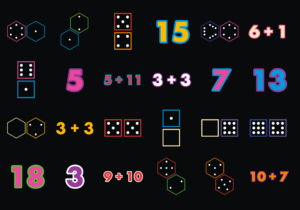
In kindergarten through Grade 2, Tile Farm Academy helps students develop an intuitive understanding of quantity, numbers, operations, shapes, patterns, and measurement while building confidence and curiosity. The ultimate goal in this grade band is to develop a strong intuition around numbers, while giving students an early joyful relationship with mathematics.
Areas of practice include:
- Subitizing
- Counting and cardinality
- One-to-one correspondence
- Counting on
- Comparing and matching quantities and numbers
- Composing and decomposing numbers
- Addition fact and subtraction fact fluency up to 20
- Derived addition fact strategies such as counting on, making ten, doubles, near doubles, decomposition, etc.
- Understanding addition and subtraction as related inverses
- Place value and groups of tens, fives, and ones
- Fluently analyzing diverse visual representations of numbers
- Early multiplicative reasoning
- Early intuition around fractions and part/whole relationships
- Number lines and numerical order
- Equality, unknown values, and algebraic thinking
- Comparing, matching, and sorting mathematical expressions
- Composing and decomposing shapes
- Using geometric vocabulary
- Spatial visualization
- Mental computation
- Story problem practice
- Asking mathematical questions
- Multi-step problem solving integrating multiple mathematical ideas
- Patterns and classification
- Estimation
- Explaining mathematical thinking
- Applying mathematical knowledge in creative contexts
Daily Digits helps students progress from counting towards more advanced concepts while developing problem solving perseverance. Number Portraits asks students to represent numbers and expressions creatively. Tile Talk helps students share ideas, listen to classmates, and explain how they solved a problem.
Mathematics in Grades 3–5
Developing Flexible and Connected Mathematical Thinking
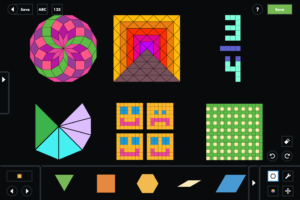
In Grades 3–5, students review early elementary concepts, master multiplication and division facts, and work with increasingly complex operations, fractions, decimals, measurement, and geometry. Tile Farm Academy helps students connect these topics while strengthening fluency, reasoning, and problem-solving. The ultimate goal in this grade band is to give students joyful mathematical experiences while developing a foundation for success in middle school math.
Areas of practice include:
- Addition and subtraction fact fluency
- Multiplication and division fact fluency
- Derived strategies for multiplication facts such as doubling or using prior knowledge
- Place value with larger numbers
- Understanding addition/subtraction and multiplication/division as inverses
- Properties of operations
- Factors, multiples, and divisibility
- Estimation and reasonableness
- Algebraic thinking and unknown quantity problems
- Comparing, matching, and sorting diverse representations of numbers and expressions
- Introduction to numerical expressions and order of operations
- Fraction equivalence, comparison, and operations
- Connections among fractions, decimals, percentages, and whole numbers
- Numerical patterns and relationships
- Shape classification and geometric relationships
- Spatial visualization
- Story problem practice
- Multi-step problem solving integrating multiple mathematical concepts
- Mathematical explanation and justification
- Applying mathematical knowledge in creative contexts
Daily Digits develops mental computation and flexible use of properties, known facts, benchmark numbers, decomposition, and composition. Number Portraits allows students to represent numbers and expressions creatively using increasingly sophisticated visual representations of concepts. Tile Talk helps students compare strategies, analyze mistakes, defend conclusions, and connect procedural fluency with conceptual understanding.
Mathematics in Grades 6–12
Strengthening Number Sense and Preparing Students for Algebra
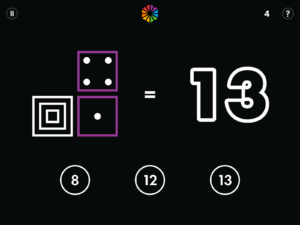
By middle school, many students have already developed a complicated or damaged relationship with math. They may see mathematics as something stressful, abstract, or disconnected from how they think. At the same time, they are often asked to work with increasingly abstract ideas before their understanding of numbers and operations is fully secure. Tile Farm Academy helps students rebuild confidence while strengthening the skills and knowledge needed for grade-level mathematics, algebra, and more advanced learning.
Areas of practice include:
- Addition, subtraction, multiplication, and division fact fluency
- Deep understanding of place value
- Intuition around fractions, decimals, and percents
- Ratios, rates, and proportional relationships
- Positive and negative numbers, and integer arithmetic
- Exponents, powers, and roots
- Numerical and algebraic expressions
- Order of operations
- Equivalent expressions
- Variables and unknown quantities
- Equations and inequalities
- Scientific notation
- Geometric vocabulary and problem solving
- Statistical reasoning and data interpretation
- Mathematical modeling
- Algebraic reasoning and generalization
- Mathematical explanation and justification
- Applying mathematical knowledge in creative contexts
Daily Digits helps students maintain and extend fluency with core number concepts that are essential for success in middle and high school math. Number Portraits provides a creative setting for applying mathematics knowledge joyfully and creatively. Tile Talk supports the analysis, justification, and mathematical reasoning required in middle school and beyond.
Common Core Mathematics Standards Supported by Tile Farm
Tile Farm Academy provides practice connected to a broad range of Common Core State Standards for Mathematics in kindergarten through Grade 8.
Its strongest areas of alignment include:
- Counting and Cardinality
- Operations and Algebraic Thinking
- Number and Operations in Base Ten
- Number and Operations—Fractions
- Ratios and Proportional Relationships
- The Number System
- Expressions and Equations
- Functions
- Geometry
- Measurement and Data
- Statistics and Probability
- All eight Standards for Mathematical Practice
Tile Farm connects to approximately 90 percent of K–5 Common Core mathematics standards through direct practice or through the reasoning, representation, fluency, discourse, and problem-solving associated with each standard.
In Grades 6–8, Tile Farm has especially strong connections to number systems, proportional reasoning, expressions, equations, functions, geometry, and algebra readiness.
The complete alignment linked below is organized by grade, mathematical domain, and individual standard. It identifies where Tile Farm provides direct practice, supporting practice, mathematical discussion, visual representation, or opportunities for application.
Alignment With State Mathematics Standards
Although the detailed standards alignment outlined in the links below uses the Common Core State Standards as its organizational framework, Tile Farm supports mathematical concepts and practices found across state standards, including:
- State-specific Common Core adaptations
- Texas Essential Knowledge and Skills
- Florida’s B.E.S.T. Standards for Mathematics
- Virginia Standards of Learning
- New York Next Generation Mathematics Learning Standards
- California Common Core State Standards for Mathematics
- Indiana Academic Standards for Mathematics
- Tennessee Academic Standards for Mathematics
- Oklahoma Academic Standards for Mathematics
- South Carolina College- and Career-Ready Standards for Mathematics
- Arizona Mathematics Standards
- New Jersey Student Learning Standards for Mathematics
- Other state college- and career-readiness frameworks
Terminology and grade placement vary, but these frameworks share an emphasis on number sense, fluency, reasoning, problem-solving, communication, representation, and algebra readiness.
State- or district-specific standards alignments may also be developed to support curriculum review, pilot planning, and adoption decisions.
Designed to Strengthen Core Instruction
Tile Farm does not replace a comprehensive core mathematics curriculum. It provides sustained practice with the mathematical ideas and habits students need to benefit more fully from grade-level instruction.
By strengthening number sense, fluency, flexibility, reasoning, spatial thinking, communication, confidence, and perseverance, Tile Farm prepares students to solve unfamiliar problems, make meaningful connections, figure things out independently, and succeed in increasingly advanced mathematics.
But most importantly, it develops a joyful relationship with mathematics for both teachers and students, an essential part of any successful math program.
Full CCSS Standards Listings
Click the links below to see the full CCSS standards alignment for Tile Farm Academy.
PreK–2:
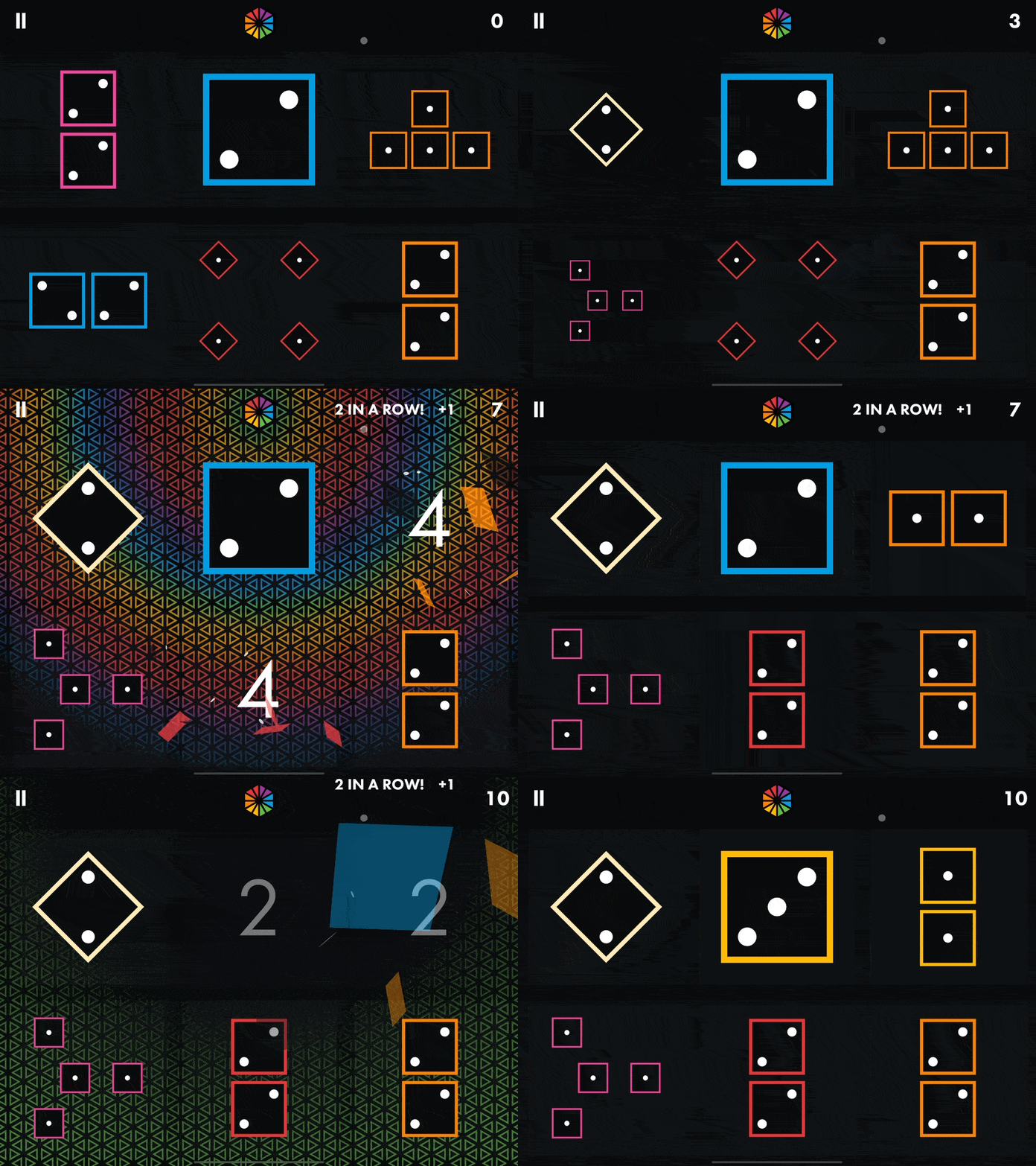
Building early number sense and a joyful relationship with math
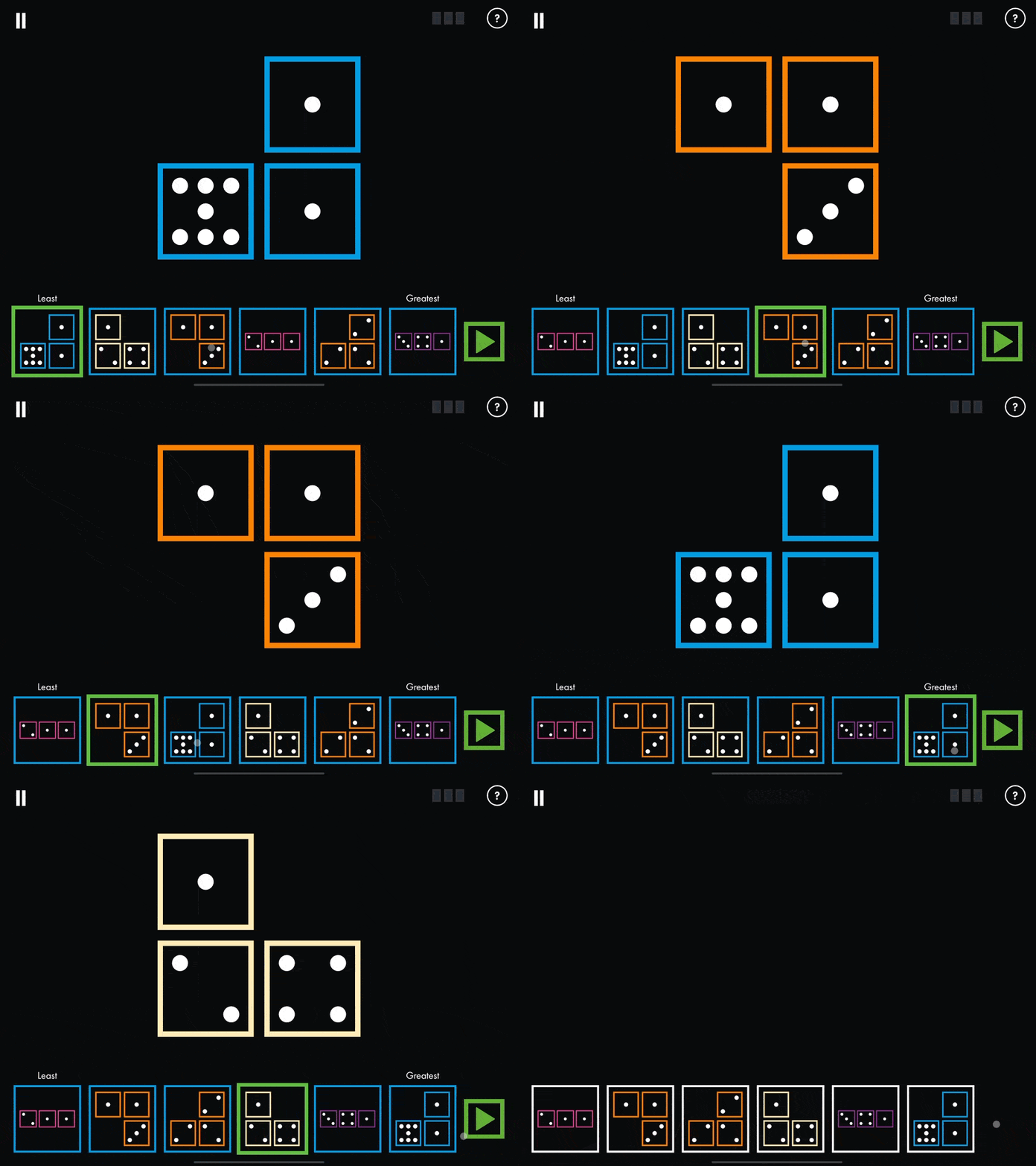
Grades 3–5:
Building fluency, flexibility, and problem-solving perseverance
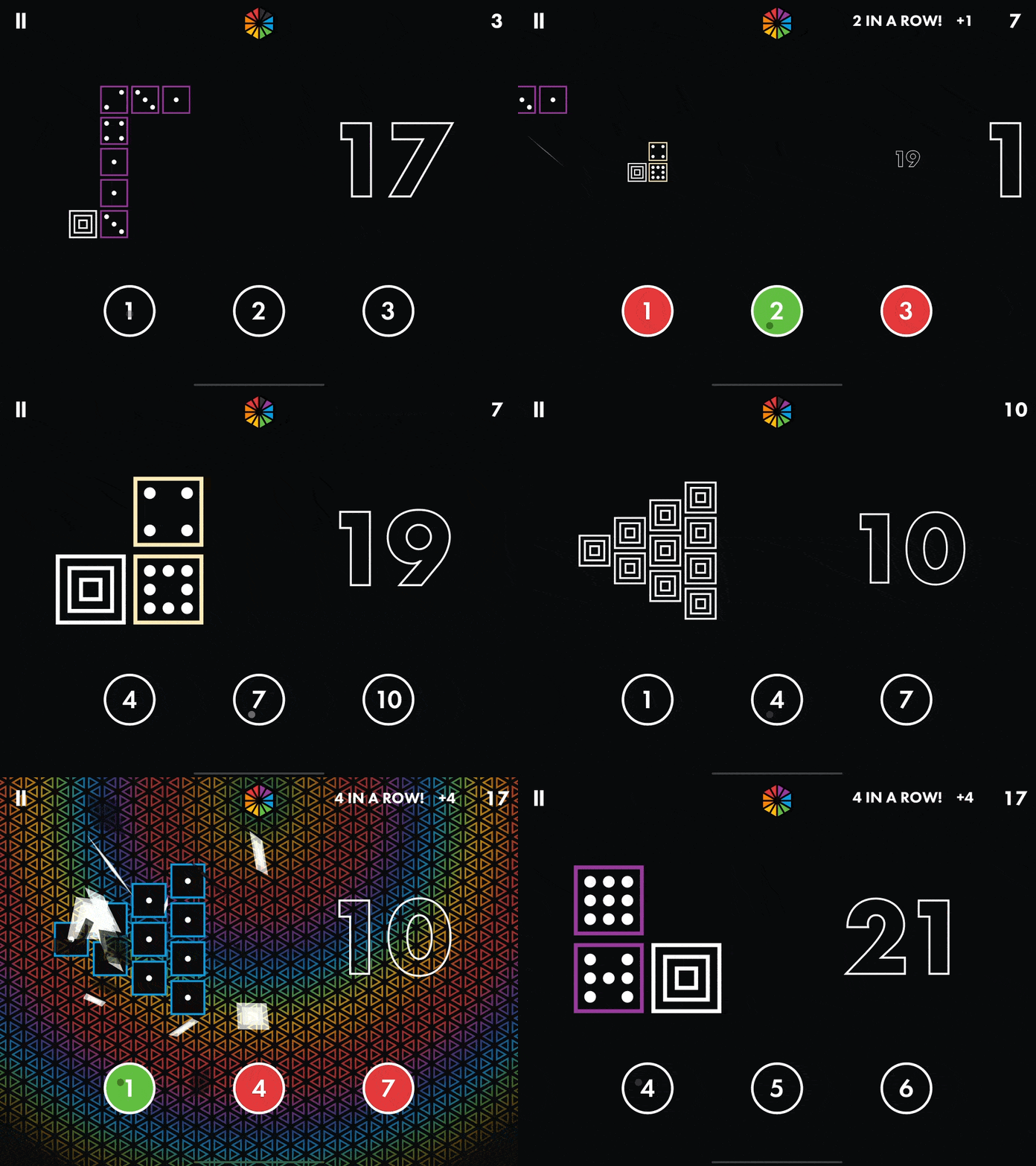
Grades 6–12:
Building confidence and a strong foundation for high school math