

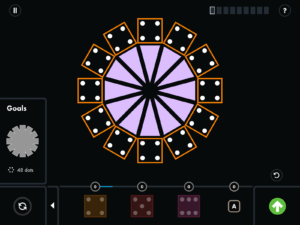
Tile Farm Academy is a supplemental daily math routine designed to strengthen number sense, fluency, reasoning, visual modeling, mathematical communication, and creative problem-solving alongside the curriculum schools already use.
The alignment below shows how Tile Farm supports key Grades 3–5 mathematical domains connected to the Common Core State Standards. Tile Farm is not intended to replace a full core curriculum. Instead, it gives students repeated, joyful opportunities to deepen the foundational ideas, flexible strategies, and habits of mind that make upper elementary mathematics more meaningful, accessible, and lasting.
Operations and Algebraic Thinking
Tile Farm Academy supports operations and algebraic thinking by helping students understand operations as relationships, structures, and tools for solving problems. Through Daily Digits, Tile Talk, and Number Portraits, students practice addition, subtraction, multiplication, and division in ways that emphasize meaning, strategy, flexibility, and explanation. Students work with unknown values, numerical patterns, properties of operations, visual representations, and multi-step problems while developing fluency that is connected to conceptual understanding.
Grade 3
3.OA.A.1
Interpret products of whole numbers.
3.OA.A.2
Interpret whole-number quotients of whole numbers.
3.OA.A.3
Use multiplication and division within 100 to solve word problems.
3.OA.A.4
Determine the unknown whole number in a multiplication or division equation.
3.OA.B.5
Apply properties of operations as strategies to multiply and divide.
3.OA.B.6
Understand division as an unknown-factor problem.
3.OA.C.7
Fluently multiply and divide within 100 using strategies based on the relationship between multiplication and division, properties of operations, and known facts.
3.OA.D.8
Solve two-step word problems using the four operations and represent problems with equations.
3.OA.D.9
Identify arithmetic patterns and explain them using properties of operations.
Grade 4
4.OA.A.1
Interpret a multiplication equation as a comparison.
4.OA.A.2
Multiply or divide to solve word problems involving multiplicative comparison.
4.OA.A.3
Solve multi-step word problems using the four operations, including problems with remainders.
4.OA.B.4
Find factor pairs, recognize multiples, and determine whether numbers are prime or composite.
4.OA.C.5
Generate and analyze number patterns.
Grade 5
5.OA.A.1
Use parentheses, brackets, or braces in numerical expressions and evaluate expressions with these symbols.
5.OA.A.2
Write, interpret, and evaluate simple numerical expressions.
5.OA.B.3
Generate two numerical patterns using given rules, identify relationships between corresponding terms, and graph ordered pairs.
Number and Operations in Base Ten
Tile Farm supports base-ten understanding by helping students see larger numbers as quantities that can be grouped, decomposed, rearranged, compared, and represented in multiple ways. Daily Digits strengthens mental computation and flexible use of place value, while Number Portraits and Tile Talk give students opportunities to represent and discuss numerical structure creatively. Students develop stronger intuition around powers of ten, multi-digit operations, estimation, and the relationship between written numbers, visual models, and efficient strategies.
Grade 3
3.NBT.A.1
Use place value understanding to round whole numbers to the nearest 10 or 100.
3.NBT.A.2
Fluently add and subtract within 1000 using strategies and algorithms based on place value, properties of operations, and the relationship between addition and subtraction.
3.NBT.A.3
Multiply one-digit whole numbers by multiples of 10 using strategies based on place value and properties of operations.
Grade 4
4.NBT.A.1
Recognize that in a multi-digit whole number, a digit in one place represents ten times what it represents in the place to its right.
4.NBT.A.2
Read, write, and compare multi-digit whole numbers using base-ten numerals, number names, and expanded form.
4.NBT.A.3
Use place value understanding to round multi-digit whole numbers.
4.NBT.B.4
Fluently add and subtract multi-digit whole numbers.
4.NBT.B.5
Multiply a whole number of up to four digits by a one-digit whole number, and multiply two two-digit numbers using strategies based on place value and properties of operations.
4.NBT.B.6
Find whole-number quotients and remainders using strategies based on place value, properties of operations, and the relationship between multiplication and division.
Grade 5
5.NBT.A.1
Recognize that in a multi-digit number, a digit in one place represents ten times as much as it represents in the place to its right and one-tenth of what it represents in the place to its left.
5.NBT.A.2
Explain patterns in the number of zeros of products and patterns in decimal placement when multiplying or dividing by powers of 10.
5.NBT.A.3
Read, write, and compare decimals to thousandths.
5.NBT.B.5
Fluently multiply multi-digit whole numbers.
5.NBT.B.6
Find whole-number quotients of whole numbers using strategies based on place value, properties of operations, and the relationship between multiplication and division.
5.NBT.B.7
Add, subtract, multiply, and divide decimals to hundredths using concrete models, drawings, strategies based on place value, properties of operations, and the relationship between operations.
Number and Operations—Fractions
Tile Farm supports fraction understanding by helping students reason about parts, wholes, equivalence, comparison, decomposition, and operations. Students encounter fractions through visual models, number relationships, creative representations, and discussion. Rather than treating fractions as isolated procedures, Tile Farm helps students see fractions as numbers that can be represented, compared, composed, decomposed, and connected to whole numbers, decimals, percentages, geometry, and measurement.
Grade 3
3.NF.A.1
Understand a fraction as a quantity formed by one part when a whole is partitioned into equal parts.
3.NF.A.2
Understand a fraction as a number on the number line.
3.NF.A.2.a
Represent fractions on a number line by partitioning the interval from 0 to 1 into equal parts.
3.NF.A.2.b
Represent fractions on a number line by marking off lengths from 0.
3.NF.A.3
Explain equivalence of fractions and compare fractions by reasoning about their size.
3.NF.A.3.a
Understand two fractions as equivalent if they are the same size or at the same point on a number line.
3.NF.A.3.b
Recognize and generate simple equivalent fractions.
3.NF.A.3.c
Express whole numbers as fractions and recognize fractions equivalent to whole numbers.
3.NF.A.3.d
Compare two fractions with the same numerator or denominator by reasoning about their size.
Grade 4
4.NF.A.1
Explain why a fraction is equivalent to another fraction by using visual fraction models.
4.NF.A.2
Compare two fractions with different numerators and different denominators by creating common denominators or numerators, or by comparing to benchmark fractions.
4.NF.B.3
Understand a fraction as a sum of fractions with the same denominator.
4.NF.B.3.a
Understand addition and subtraction of fractions as joining and separating parts referring to the same whole.
4.NF.B.3.b
Decompose a fraction into a sum of fractions with the same denominator in more than one way.
4.NF.B.3.c
Add and subtract mixed numbers with like denominators.
4.NF.B.3.d
Solve word problems involving addition and subtraction of fractions with like denominators.
4.NF.B.4
Apply and extend previous understandings of multiplication to multiply a fraction by a whole number.
4.NF.B.4.a
Understand a fraction as a multiple of a unit fraction.
4.NF.B.4.b
Understand a multiple of a fraction as a multiple of a unit fraction.
4.NF.B.4.c
Solve word problems involving multiplication of a fraction by a whole number.
4.NF.C.5
Express a fraction with denominator 10 as an equivalent fraction with denominator 100.
4.NF.C.6
Use decimal notation for fractions with denominators 10 or 100.
4.NF.C.7
Compare two decimals to hundredths by reasoning about their size.
Grade 5
5.NF.A.1
Add and subtract fractions with unlike denominators by replacing given fractions with equivalent fractions.
5.NF.A.2
Solve word problems involving addition and subtraction of fractions with unlike denominators.
5.NF.B.3
Interpret a fraction as division of the numerator by the denominator.
5.NF.B.4
Apply and extend previous understandings of multiplication to multiply a fraction or whole number by a fraction.
5.NF.B.4.a
Interpret the product of a fraction and a whole number or fraction.
5.NF.B.4.b
Find the area of a rectangle with fractional side lengths by tiling and relate it to multiplication.
5.NF.B.5
Interpret multiplication as scaling.
5.NF.B.6
Solve real-world problems involving multiplication of fractions and mixed numbers.
5.NF.B.7
Apply and extend previous understandings of division to divide unit fractions by whole numbers and whole numbers by unit fractions.
Measurement and Data
Tile Farm supports measurement and data concepts through comparison, classification, visual representation, estimation, geometry, number relationships, and mathematical discussion. While Tile Farm’s deepest emphasis is number sense and visual reasoning, many activities ask students to interpret quantities, organize information, reason about units, use measurement ideas in context, and connect numerical relationships to visual models.
Grade 3
3.MD.B.3
Draw scaled picture graphs and bar graphs and solve problems using information from graphs.
3.MD.B.4
Generate measurement data and show the data on a line plot.
3.MD.C.5
Recognize area as an attribute of plane figures and understand concepts of area measurement.
3.MD.C.6
Measure areas by counting unit squares.
3.MD.C.7
Relate area to multiplication and addition.
3.MD.D.8
Solve problems involving perimeters of polygons.
Grade 4
4.MD.A.2
Use the four operations to solve word problems involving distances, intervals of time, liquid volumes, masses, and money.
4.MD.A.3
Apply area and perimeter formulas for rectangles in real-world and mathematical problems.
4.MD.C.5
Recognize angles as geometric shapes formed by two rays and understand concepts of angle measurement.
4.MD.C.7
Recognize angle measure as additive.
Grade 5
5.MD.A.1
Convert among different-sized standard measurement units within a given measurement system.
5.MD.B.2
Make a line plot to display a data set of measurements in fractions of a unit.
5.MD.C.3
Recognize volume as an attribute of solid figures and understand concepts of volume measurement.
5.MD.C.4
Measure volumes by counting unit cubes.
Geometry
Tile Farm is inherently geometrical and supports geometry through visual composition and decomposition, spatial reasoning, symmetry, patterning, design, classification, and development of geometric vocabulary. In Number Portraits especially, students use shapes and digital manipulatives to build, arrange, transform, and describe mathematical ideas. Students learn that shapes can be combined, broken apart, compared, rotated, repeated, classified, and used as tools for representing number relationships.
Grade 3
3.G.A.1
Understand that shapes in different categories may share attributes and that shared attributes can define a larger category.
3.G.A.2
Partition shapes into parts with equal areas and express the area of each part as a unit fraction of the whole.
Grade 4
4.G.A.2
Classify two-dimensional figures based on the presence or absence of parallel or perpendicular lines and angles of specified size.
4.G.A.3
Recognize a line of symmetry for a two-dimensional figure and identify and draw lines of symmetry.
Grade 5
5.G.B.3
Understand that attributes belonging to a category of two-dimensional figures also belong to all subcategories of that category.
5.G.B.4
Classify two-dimensional figures in a hierarchy based on properties.
Standards for Mathematical Practice in Grades 3–5
Tile Farm also supports the Standards for Mathematical Practice in Grades 3–5 by giving students frequent opportunities to reason, model, explain, create, revise, and look for structure in mathematical situations.
MP1. Make sense of problems and persevere in solving them
Students work through visual and numerical challenges that encourage persistence, strategy testing, revision, and problem-solving stamina.
MP2. Reason abstractly and quantitatively
Students connect quantities, symbols, visual models, diagrams, expressions, and explanations as they move between concrete, visual, and abstract representations.
MP3. Construct viable arguments and critique the reasoning of others
Tile Talk and classroom discussion invite students to explain strategies, compare approaches, analyze mistakes, and respond to the reasoning of classmates.
MP4. Model with mathematics
Number Portraits and visual routines help students represent mathematical relationships using quantities, shapes, arrays, patterns, diagrams, expressions, and digital manipulatives.
MP5. Use appropriate tools strategically
Students choose from different visual tools and representations, learning that different tools can reveal different mathematical relationships.
MP6. Attend to precision
Students calculate carefully, use mathematical vocabulary, label representations, and communicate strategies and visual designs with increasing clarity and accuracy.
MP7. Look for and make use of structure
Tile Farm’s visual environments help students notice structure in place value, multiplication, division, fractions, factors, multiples, symmetry, area, volume, and numerical patterns.
MP8. Look for and express regularity in repeated reasoning
Students reuse familiar structures and strategies across activities, helping them move from solving individual problems toward recognizing broader mathematical patterns and generalizations.
Summary
Across Grades 3–5, Tile Farm Academy supports the development of flexible and connected mathematical thinking: fluency with the four operations, place value, fractions, decimals, measurement, geometry, data, reasoning, and mathematical communication.
Most importantly, Tile Farm helps students experience mathematics as something joyful, creative, and deeply understandable—something they can see, build, discuss, and explore. Through playful daily routines, visual problem-solving, math talk, and creative work like Number Portraits, students develop not only standards-based skills, but also the confidence, curiosity, perseverance, and flexible thinking they need for long-term success in mathematics.