Subscribe to the Tile Farm Tribune
Our free monthly newsletter: Tile Farm news and events, classroom tips and inspiration, and activity spotlights you can use right away.


Number sense is having a moment.
At its core, number sense is the ability to make sense of numbers: to understand their size, see relationships, break them apart and put them back together, and use them flexibly to solve problems. It is the difference between simply remembering a procedure and being able to reason your way through the math.
Number sense is woven throughout grade-level standards, but it is more than another skill to master. Number sense is the foundation that makes the rest of mathematics easier to learn.
Educators and policymakers are taking notice. California’s new Mathematics Framework puts number sense front and center, and states including Kentucky and Iowa are following with new legislation focused on stronger math foundations.
So why does number sense matter so much?
Here are four big ideas.
Strong number sense makes all mathematics easier to learn.
One analogy we like to use is reading. Imagine trying to understand a complex passage while having to sound out every word and occasionally stop to look up its meaning. You might eventually get through it, but it would be difficult to focus on the bigger ideas.
Math can work the same way.
Strong number sense gives students an intuitive understanding of quantities and relationships, freeing them to focus on problem solving and new concepts rather than struggling with the numbers themselves.
From fractions and word problems to algebra and advanced mathematics, strong number sense makes new learning easier to understand and connect.
There is something important hidden in the phrase number sense: numbers make sense.
For students with strong number sense, math isn’t just a collection of facts and procedures to remember. There are relationships they can see and ideas they can reason through.
A student who sees 19 + 7 and recognizes that they can move 1 from the 7 to make 20 + 6 has something to fall back on. If they forget a memorized fact or procedure, they aren’t stuck. They can think.
Over time, these experiences build a powerful feeling of mathematical confidence: I can figure this out.
And when students feel capable of figuring things out, they are much more willing to engage, take risks, share their thinking, and enjoy mathematics.
Every teacher has experienced the frustration of starting a lesson only to discover that students are missing the prerequisite understanding they need.
The multiplication lesson becomes an addition lesson. The algebra lesson becomes a lesson on fractions. Often, students learned a procedure without developing enough intuition for the mathematics to stick or transfer.
Strong number sense changes that.
When students understand how numbers behave, new learning has something to connect to. Teachers can spend more time on the mathematics they are actually trying to teach and less time rebuilding foundations.
Number sense isn’t one more thing to fit into an already crowded math block. It can make the rest of the math block work better.
Part of our job as teachers is preparing students for the world they are entering. From voting and shopping to applying for a job or deciding whether a claim is believable, numbers are everywhere.
Prices, percentages, wages, graphs, statistics, probabilities, and data all require more than knowing how to calculate. Students need an intuition for numbers. Does this seem reasonable? How big is this difference really? Which option is actually better?
Number sense isn’t just preparation for the next math class. It helps students become informed, capable participants in the world around them.
In an increasingly numerical world, number sense is a form of literacy.
Strong number sense develops when students experience numbers in different ways. Tile Farm Academy takes a three-pronged approach: individual practice, creative application, and mathematical discourse. Together, these modes give students multiple ways to build, apply, and express their understanding of numbers.
Daily Digits provides the individual practice. Students solve problems using multiple representations and strategies, building flexible thinking, problem-solving skills, and stronger intuitions about how numbers work.
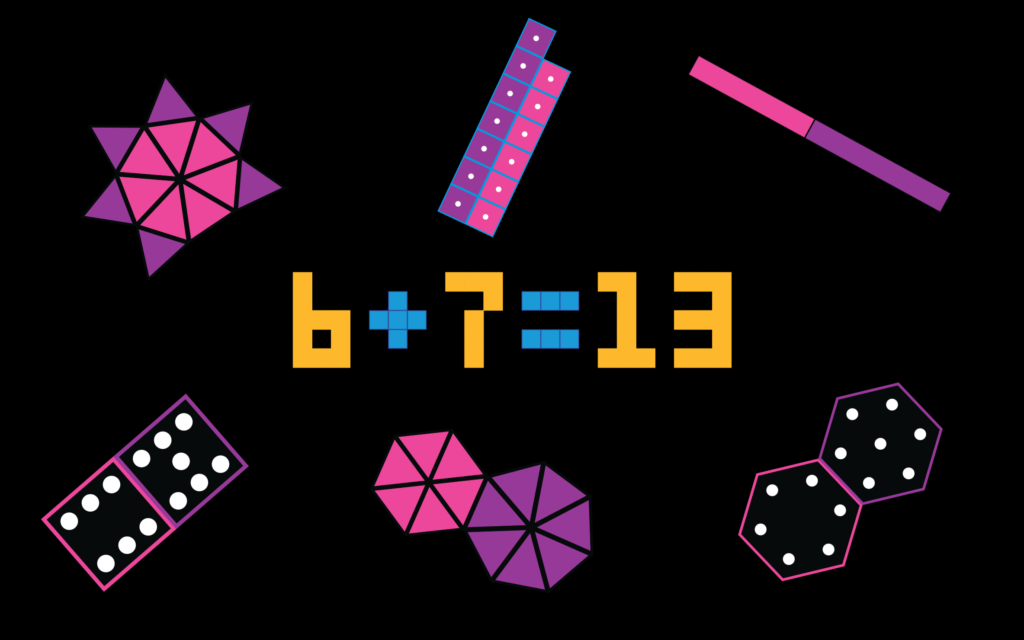
Number Portraits put students’ number sense into practice through creative application, like in the representations of 6 + 7 shown above. Students use what they know about numbers, operations, and relationships to create mathematical representations and make new connections.
Tile Talk develops mathematical discourse. Students build the vocabulary and communication skills to explain their thinking, compare strategies, and learn from the different ways their classmates approach the same mathematical idea.
Together, these three approaches help students become more flexible and confident mathematical thinkers.
The goal isn’t simply to help students calculate faster.
It’s to help numbers make sense.
Our free monthly newsletter: Tile Farm news and events, classroom tips and inspiration, and activity spotlights you can use right away.