Subscribe to the Tile Farm Tribune
Our free monthly newsletter: Tile Farm news and events, classroom tips and inspiration, and activity spotlights you can use right away.


Beyond our work at Tile Farm, everyone on our team teaches in a variety of settings. The NCTM annual meeting in Denver was a chance to share our ideas, learn from fellow educators, and bring fresh thinking to both our teaching and the content we create.
Highlighted below are a few of our favorite sessions we attended in Denver:
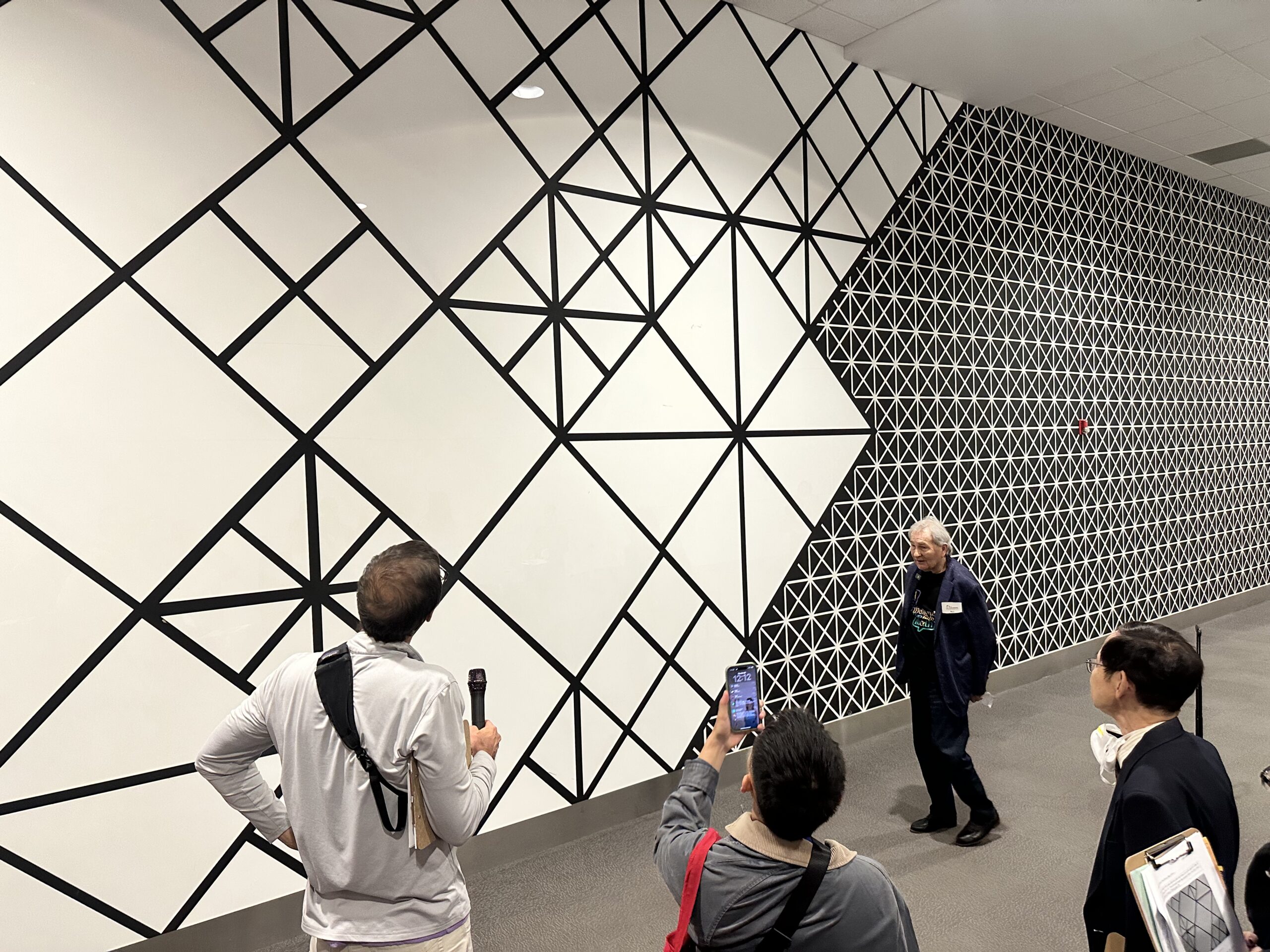
Ron Lancaster’s math walk was arguably the most unique session we went to in Denver. This session involved walking around the Colorado Convention Center, noticing, wondering, estimating, and calculating. At one point somebody found a visual proof of the Pythagorean theorem in a tile wall (pictured above), at another point the crowd estimated the rate of the massive escalators in the convention center, and at various points we appreciated beautiful art around the convention center.
We loved the overall playfulness of the walk, and how it prompted participants to see the depth of math in everything around them. Math is often overly confined to worksheets and whiteboards, but seeing it in the world around you can really be eye opening. We are excited to bring math walks to our own teaching practices, and think they are a great idea for any teacher.
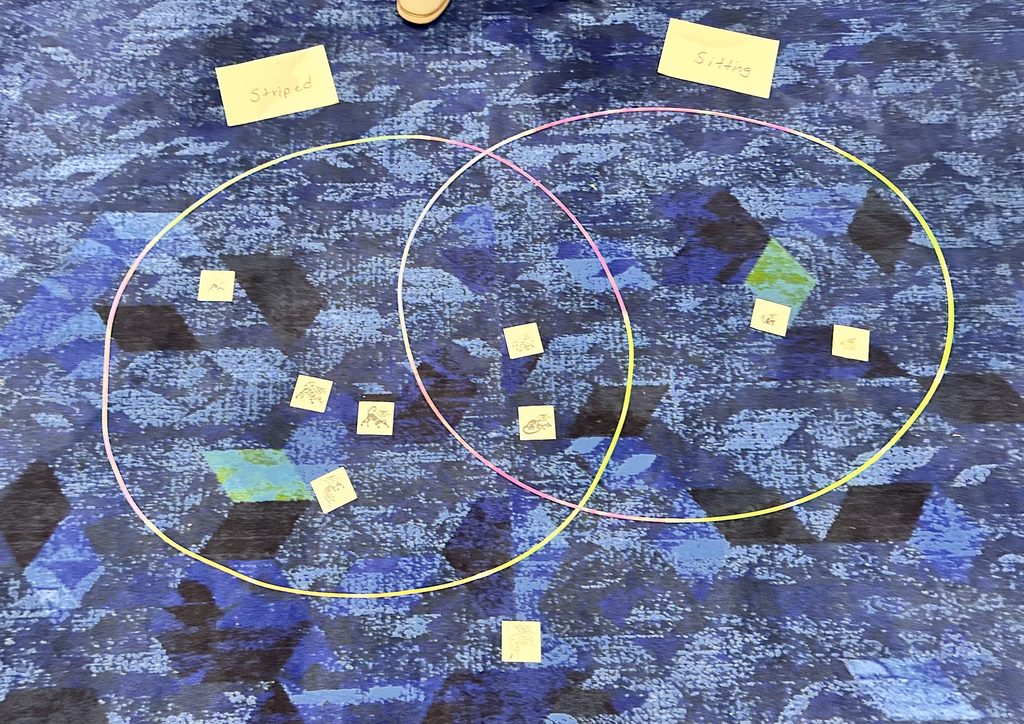
Jeremy Winters, Cynthia Cliche, Dovie L Kimmins presented a session on Venn diagrams, the overall theory of them, and how they can be used in both ELA and math, for both sorting and contrasting. At one point in the sessino we sorted cats based on different attributes as pictured above. We love how Venn diagrams engage students in deep thinking and bring together the NCTM process standards. Venn diagrams are a great way to promote problem solving, connections, communication, and teaching mathematical thinking, especially in K-2 learners, the target of this session.
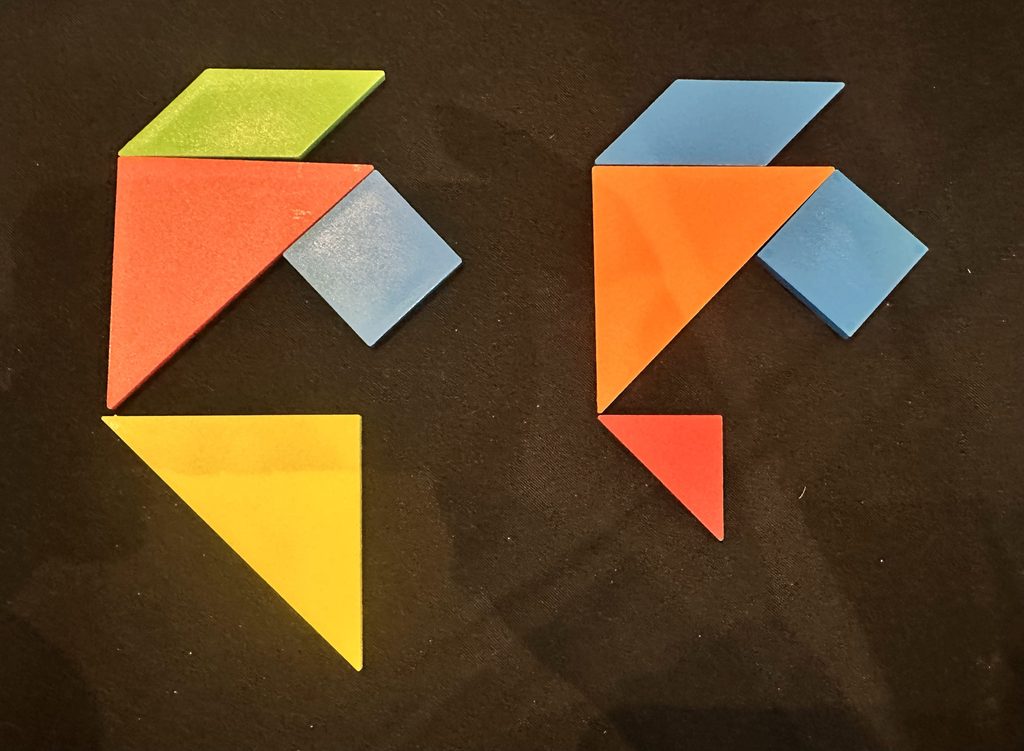
Becky Holden presented a session on the “Same and Different” routine targeted at PreK-2 teachers. One amazing thing about this routine is how simple it is to understand and implement. Almost any teacher can run this immediately, and their students will know exactly what to do. This can be done with anything, whether it is comparing mathematical expressions, chairs in your classroom, trees, or what students had for lunch today versus yesterday. It is an amazing way of developing vocabulary through children’s natural curiosity. On top of that, we love how the same comparison skills developed with this routine in preschool are relevant throughout life, whether you are shopping at the grocery, comparing medicines, or designing a scientific study.
During this session we also had the opportunity to create our own “Same and Different” images using manipulatives as pictured above. This directly related to our session we presented on student generated math problems, and would be a fun activity for students to do in Tile Farm Studio.
We have been fans of Jennifer Bay-Williams’ work for years, and her overall approach and thoughts around number sense and fluency. Her session, presented with Sarah Schaefer, first defined fluency as a combination of 3 things: accuracy, efficiency, and flexibility. Flexibility in particular is often left out of fluency worksheets, and is essential if we want learners to be able to utilize their fluency as they advance to higher mathematics.
Their session also highlighted a developmental approach to fluency, which involves first counting, then deriving, then mastery. For example, multiples of 2, 4, and 8 are taught alongside each other, first using strategies involving doubling, before students fully develop mastery. This approach gives students a fallback in case they forget a fact, while deepening their conceptual understanding, and giving them strategies they can apply elsewhere. We use the same approach in our Daily Digits curriculum.
Karina Lorena Moran presented a lively session on number lines. She highlighted how they are under-mentioned in the CCSS standards, but her home state of Florida has placed a much heavier emphasis on them in their curriculum. We learned about number lines in all different forms including number paths, beaded number lines, and open number lines, and this session really got us thinking about developing more games and puzzles in Tile Farm centered around number lines.
Karen Karp presented a heartwarming session about an intervention technique called “priming.” This involves taking a proactive approach to intervention, which involves prepping students with foundational knowledge they will use in future lessons in their main classroom. Then when students encounter the lesson in their main classroom, the students come into the lesson prepared to shine. Giving students who have struggled with math an opportunity to mathematically shine in front of their peers can go an incredibly long way in transforming those students’ relationship with math.
Susie Katt shared a joyful session that parallels something we think about a lot at Tile Farm: the emotional side of math learning. While our approach is largely focused on the mathematical content itself, Susie Katt’s session highlighted a lot of fun ideas to positively shift classroom culture around math learning. This included ideas like having students write about their math superpower, highlighting a student mathematician of the week, or having a “math party” for your class or school.
Across these sessions, we appreciated the many ways teachers are helping students think deeply, build confidence, and find joy in math. We left Denver with plenty of ideas to try in our own teaching and explore further at Tile Farm. Thanks to all the presenters who shared their ideas and gave us so much to think about!
Our free monthly newsletter: Tile Farm news and events, classroom tips and inspiration, and activity spotlights you can use right away.