


A growing focus in math education is Math Talks, which generally shift the focus away from right answers and instead get students talking about how they think and what they notice.
Tile Talk is Tile Farm’s version of that idea. It uses visual math prompts to help spark short, lively classroom discussions, is fun and social, and is great for developing number sense.
This blog focuses on a few easy moves if you are trying Tile Talk for the first time.
Start with Discuss It: Daily Digits
When trying Tile Talk for the first time, the easiest activity to begin with is Discuss It: Daily Digits.
This activity curates problems your students may have struggled with in their individual Daily Digits and makes them easy to discuss together.
Even doing this once a week can do wonders for students’ number sense, helping them build mathematical language, develop new problem-solving strategies, and become more patient and thorough mathematical thinkers.
To access it, simply log in to your Dashboard, then click Tile Talk → Discuss It: Daily Digits.
First Ask: What do you notice?
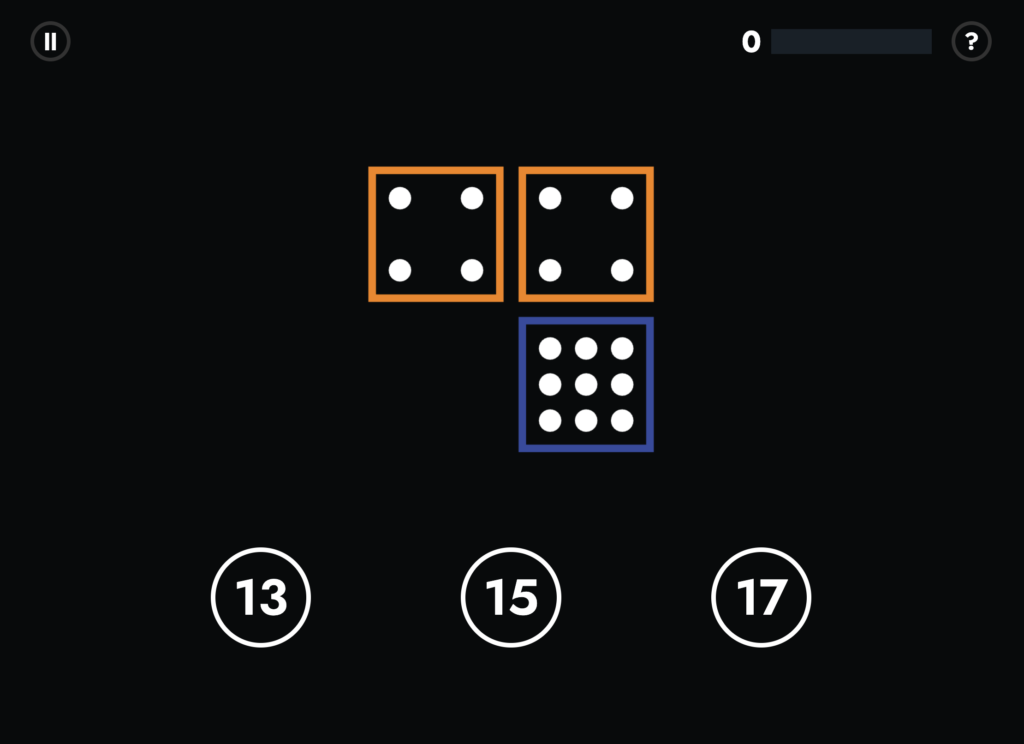
Because Daily Digits relies heavily on visual math, there is usually a lot to notice.
At this point, students do not need to solve the problem, and there isn’t a single right thing to notice. The goal is simply to get students to slow down, look carefully, and share what they see. Learning to do this will go a long way in helping students organize their thinking around more complex problems in the future.
A great move is to make a list of their noticings on the board. For the problem above, students might notice:
- There are 3 squares
- There are 2 different colors of squares
- The answer choices all differ by 2
- All of the answers start with a 1
- All of the answers are odd numbers
- The dots in each square also make a square
- There are twice as many orange squares as dark blue ones
- There are 8 dots in the orange squares
- There are 9 dots in the dark blue square
Next Ask: How would you solve it?
After you have made a good list of what students notice, invite a student to explain how they would solve the problem.
Try to let students do most of the talking. If they get stuck, simple prompts like “What did you do first?” or “Can you show us?” can help.
The goal isn’t a perfect explanation. It’s giving students practice putting their mathematical thinking into words.
Then Ask: Did anybody solve it differently?
This is where the discussion can get especially interesting.
Many problems can be seen or solved in multiple ways. Hearing different strategies helps students become more flexible thinkers and helps them see that their classmates may notice or approach the same problem in completely different ways.
For example, in the problem above, one student might first see 4 + 4 = 8, then add 8 + 9. Another student might move a dot from one of the groups of 4 to turn the 9 into 10, then add the remaining 3 + 4.
Keep It Simple
Try this routine with your students using a few problems each week. It can do wonders for their number sense, while also helping them become more patient, thorough observers and more thoughtful problem solvers.
Those habits reach far beyond math. Learning to slow down, notice details, explain your thinking, listen to different perspectives, and consider more than one way to approach a problem are valuable skills in just about everything students do.
And students often love the opportunity to share their thinking. Along the way, you will also gain a much better understanding of how they think about math.