

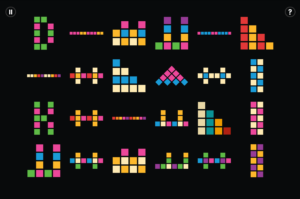
Tile Farm Academy is a supplemental daily math routine designed to strengthen number sense, fluency, reasoning, visual modeling, mathematical communication, and creative problem-solving alongside the curriculum schools already use.
The alignment below shows how Tile Farm supports key K–2 mathematical domains connected to the Common Core State Standards. Tile Farm is not intended to replace a full core curriculum. Instead, it gives students repeated, joyful opportunities to build the foundational ideas and habits of mind that make grade-level mathematics more meaningful, accessible, and lasting.
Counting and Cardinality
Tile Farm Academy supports counting and cardinality by helping young students connect number words, written numerals, quantities, and visual representations. Through Daily Digits, Tile Talk, and Number Portrait activities, students practice subitizing, counting on, comparing quantities, matching numbers to sets, and seeing numbers as meaningful amounts rather than isolated symbols. Students who use Tile Farm Academy develop flexible counting strategies, and can use their knowledge creatively and joyfully to build quantitative art pieces in Number Portraits.
Kindergarten Counting and Cardinality Standards Covered by Tile Farm Academy:
K.CC.A.1
Count to 100 by ones and tens.
K.CC.A.2
Count forward from a given number instead of always beginning at 1.
K.CC.A.3
Write numbers from 0 to 20 and represent a set of objects with a written numeral.
K.CC.B.4
Understand the relationship between counting and quantity.
K.CC.B.4.a
Pair each object with one number name when counting.
K.CC.B.4.b
Understand that the last number counted tells how many objects are in the group.
K.CC.B.4.c
Understand that each number in the counting sequence represents one more.
K.CC.B.5
Count objects in different arrangements and count out a given number of objects.
K.CC.C.6
Compare groups of objects as greater than, less than, or equal to another group.
K.CC.C.7
Compare two written numerals between 1 and 10.
Operations and Algebraic Thinking
Tile Farm supports operations and algebraic thinking by helping students see addition and subtraction as actions, relationships, and structures. Students combine, separate, compare, decompose, and transform numbers using visual models, digital manipulatives, math talks, and creative representations. Rather than treating facts as isolated answers to memorize, Tile Farm Academy helps students develop flexible strategies and meaningful fluency and can be applied in diverse problem solving contexts.
Kindergarten Operations and Algebraic Thinking Standards Covered By Tile Farm Academy:
K.OA.A.1
Represent addition and subtraction using objects, drawings, actions, sounds, verbal explanations, expressions, or equations.
K.OA.A.2
Solve addition and subtraction word problems and add and subtract within 10 using objects or drawings.
K.OA.A.3
Decompose numbers up to 10 into pairs in more than one way.
K.OA.A.4
Find the number that makes 10 when added to a given number from 1 to 9.
K.OA.A.5
Fluently add and subtract within 5.
Grade 1 Operations and Algebraic Thinking Standards Covered By Tile Farm Academy:
1.OA.A.1
Use addition and subtraction within 20 to solve word problems involving adding to, taking from, putting together, taking apart, and comparing.
1.OA.A.2
Solve word problems that involve adding three whole numbers with sums up to 20.
1.OA.B.3
Use properties of operations as strategies for addition and subtraction.
1.OA.B.4
Understand subtraction as an unknown-addend problem.
1.OA.C.5
Relate counting to addition and subtraction.
1.OA.C.6
Add and subtract within 20, demonstrating fluency within 10, using strategies such as counting on, making ten, decomposing numbers, using the relationship between addition and subtraction, and creating easier equivalent sums.
1.OA.D.7
Understand the meaning of the equal sign and determine whether addition and subtraction equations are true or false.
1.OA.D.8
Find an unknown whole number in an addition or subtraction equation.
Grade 2 Operations and Algebraic Thinking Standards Covered By Tile Farm Academy:
2.OA.A.1
Use addition and subtraction within 100 to solve one- and two-step word problems with unknowns in different positions.
2.OA.B.2
Fluently add and subtract within 20 using mental strategies.
2.OA.C.3
Determine whether a group of objects has an odd or even number of members, including by pairing objects or counting by twos.
2.OA.C.4
Use addition to find the total number of objects in rectangular arrays and write equations as sums of equal addends.
Number and Operations in Base Ten
Tile Farm supports base-ten understanding by helping students see numbers as quantities that can be grouped, decomposed, rearranged, compared, and represented in multiple ways. Daily Digits, Number Portraits, and Tile Talk give students repeated opportunities to work with tens, ones, fives, and hundreds in ways that develop deep intuition and flexible strategies than can be used for more complex oprations.
Kindergarten Number and Operations in Base Ten Standards Covered By Tile Farm Academy:
K.NBT.A.1
Compose and decompose numbers from 11 to 19 into ten ones and additional ones, building early foundations for place value.
Grade 1 Number and Operations in Base Ten Standards Covered By Tile Farm Academy:
1.NBT.A.1
Count to 120, starting at any number less than 120, and read, write, and represent numbers in that range.
1.NBT.B.2
Understand that the two digits of a two-digit number represent tens and ones.
1.NBT.B.2.a
Understand 10 as a bundle of ten ones.
1.NBT.B.2.b
Understand numbers from 11 to 19 as one ten and some ones.
1.NBT.B.2.c
Understand decade numbers as groups of tens with zero ones.
1.NBT.B.3
Compare two two-digit numbers using the meanings of tens and ones and record comparisons using symbols.
1.NBT.C.4
Add within 100 using models, drawings, place-value strategies, properties of operations, and the relationship between addition and subtraction.
1.NBT.C.5
Mentally find 10 more or 10 less than a two-digit number and explain the reasoning.
1.NBT.C.6
Subtract multiples of 10 from multiples of 10 using models, drawings, place-value strategies, properties of operations, and the relationship between addition and subtraction.
Grade 2 Number and Operations in Base Ten Standards Covered By Tile Farm Academy:
2.NBT.A.1
Understand that the three digits of a three-digit number represent hundreds, tens, and ones.
2.NBT.A.1.a
Understand 100 as a bundle of ten tens.
2.NBT.A.1.b
Understand hundred numbers as groups of hundreds with zero tens and zero ones.
2.NBT.A.2
Count within 1000 and skip-count by 5s, 10s, and 100s.
2.NBT.A.3
Read and write numbers to 1000 using numerals, number names, and expanded form.
2.NBT.A.4
Compare two three-digit numbers using the meanings of hundreds, tens, and ones and record comparisons using symbols.
2.NBT.B.5
Fluently add and subtract within 100 using strategies based on place value, properties of operations, and the relationship between addition and subtraction.
2.NBT.B.6
Add up to four two-digit numbers using strategies based on place value and properties of operations.
2.NBT.B.7
Add and subtract within 1000 using models, drawings, place-value strategies, properties of operations, and the relationship between addition and subtraction.
2.NBT.B.8
Mentally add or subtract 10 or 100 from a given number between 100 and 900.
2.NBT.B.9
Explain why addition and subtraction strategies work using place value and properties of operations.
Measurement and Data
Tile Farm supports measurement and data concepts through comparison, classification, ordering, visual representation, and mathematical discussion. While Tile Farm’s deepest emphasis is number sense and visual reasoning, many activities invite students to compare attributes, organize information, notice categories, interpret visual arrangements, and reason about quantities in context.
Kindergarten Measurement and Data Standards Covered By Tile Farm Academy:
K.MD.A.1
Describe measurable attributes of objects, such as length, height, size, or weight.
K.MD.A.2
Directly compare two objects with a measurable attribute in common.
K.MD.B.3
Classify objects into categories, count the number in each category, and sort categories by count.
Grade 1 Measurement and Data Standards Covered By Tile Farm Academy:
1.MD.A.1
Order objects by length and compare lengths indirectly using another object.
1.MD.A.2
Measure length by using repeated same-size units with no gaps or overlaps.
1.MD.C.4
Organize, represent, and interpret data with up to three categories.
Grade 2 Measurement and Data Standards Covered By Tile Farm Academy:
2.MD.A.2
Measure the same object using different length units and describe how the measurements relate to the unit size.
2.MD.A.4
Measure to determine how much longer one object is than another.
2.MD.C.8
Solve word problems involving coins and dollar bills.
2.MD.D.9
Generate measurement data and represent it on a line plot.
2.MD.D.10
Draw picture graphs and bar graphs and solve simple problems using information from the graphs.
Geometry
Tile Farm is inherently geometrical, and supports geometry through visual composition and decomposition, spatial reasoning, symmetry, patterning, design, and development of geometric vocabulary. In Number Portraits especially, students use shapes and digital manipulatives to build, arrange, transform, and describe mathematical ideas. Students learn that shapes can be combined, broken apart, compared, rotated, repeated, and used as tools for representing number relationships.
Kindergarten Geometry Standards Covered By Tile Farm Academy:
K.G.A.1
Describe objects in the environment using shape names and positional language.
K.G.A.2
Name shapes correctly regardless of size or orientation.
K.G.B.4
Analyze and compare two- and three-dimensional shapes using informal language about attributes, parts, and similarities.
K.G.B.5
Model shapes by building and drawing them.
K.G.B.6
Compose simple shapes to form larger shapes.
Grade 1 Geometry Standards Covered By Tile Farm Academy:
1.G.A.1
Distinguish between defining and non-defining attributes of shapes and build or draw shapes with defining attributes.
1.G.A.2
Compose two-dimensional or three-dimensional shapes to create composite shapes and compose new shapes from composite shapes.
1.G.A.3
Partition circles and rectangles into two and four equal shares and describe the shares as halves, fourths, and quarters.
Grade 2 Geometry Standards Covered By Tile Farm Academy:
2.G.A.1
Recognize and draw shapes with specified attributes, including triangles, quadrilaterals, pentagons, hexagons, and cubes.
2.G.A.2
Partition a rectangle into rows and columns of same-size squares and count to find the total.
2.G.A.3
Partition circles and rectangles into two, three, or four equal shares and describe the shares as halves, thirds, and fourths.
Standards for Mathematical Practice in K–2
Tile Farm also supports the Standards for Mathematical Practice in K-2 by giving students frequent opportunities to reason, model, explain, create, revise, and look for structure in mathematical situations.
MP1. Make sense of problems and persevere in solving them
Students explore visual and numerical challenges that encourage persistence, strategy testing, and revision.
MP2. Reason abstractly and quantitatively
Students connect quantities, symbols, diagrams, and visual models as they move between concrete and abstract representations.
MP3. Construct viable arguments and critique the reasoning of others
Tile Talk and classroom discussion invite students to explain their ideas, compare strategies, and respond to the reasoning of classmates.
MP4. Model with mathematics
Number Portraits and visual routines help students represent mathematical relationships using quantities, shapes, patterns, diagrams, and digital manipulatives.
MP5. Use appropriate tools strategically
Students choose from different visual tools and representations, learning that different tools reveal different mathematical relationships.
MP6. Attend to precision
Students describe patterns, quantities, strategies, and visual designs with increasing clarity and accuracy.
MP7. Look for and make use of structure
Tile Farm’s visual environments help students notice structure in numbers, shapes, patterns, symmetry, place value, and operations.
MP8. Look for and express regularity in repeated reasoning
Students reuse familiar structures and strategies across activities, helping them move from individual answers toward broader mathematical generalizations.
Summary
Across kindergarten through Grade 2, Tile Farm Academy supports the development of strong early mathematical foundations: counting, cardinality, operations, place value, visual representation, geometry, measurement, data, reasoning, and mathematical communication.
Most importantly, Tile Farm helps students experience mathematics as something joyful, creative, and deeply understandable—something they can see, build, discuss, and explore. Through playful daily routines, visual problem-solving, math talk, and project-based learning creative work like Number Portraits, students develop not only standards-based skills, but also the confidence, curiosity, and flexible thinking they need for long-term success in mathematics.