

The first month of the Spring 2026 Tile Farm Teacher Fellowship focused on “How Many”, a Tile Talk activity centered on creative question asking.
Teacher Fellows were invited to play with the activity on their own, try it out with their students, and create their own “How Many” prompts using Tile Farm Studio. Across these experiences, three key takeaways emerged:
- Through reflection and classroom use, both teachers and students initially showed hesitation around asking questions.
- As the activity unfolded, students became noticeably more comfortable asking questions, leading to a shift in classroom culture.
- The opportunity to create their own prompts was especially engaging and powerful for both teachers and students.
Below you’ll find some of our favorite responses to each of the three weekly prompts.
Week 1: Play & Reflect
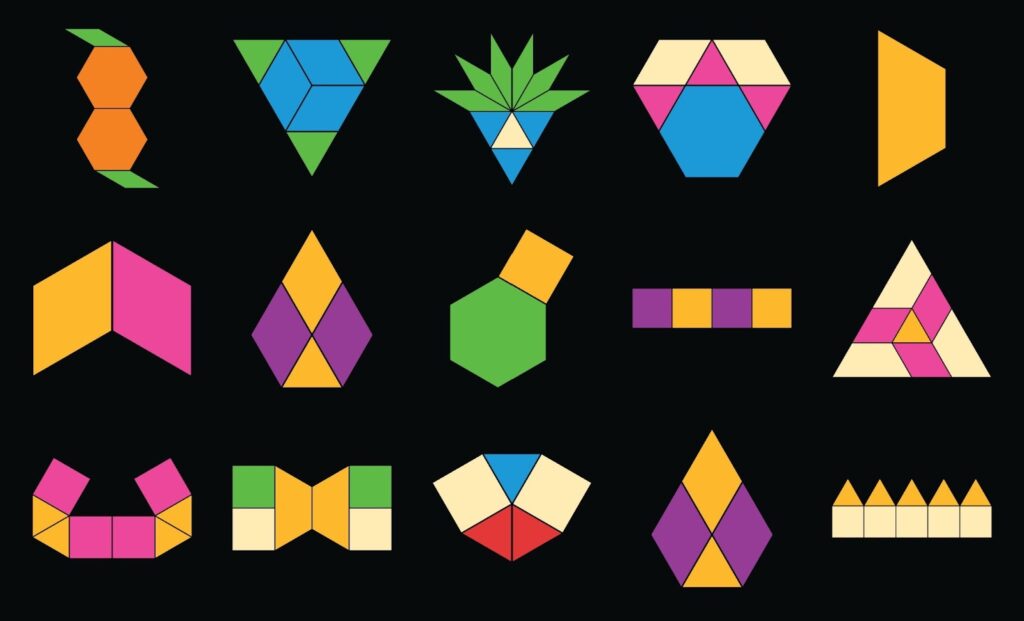
Before trying the activity with their classes, we asked teachers to first come up with “How Many”-style questions for the image above. We received hundreds of thoughtful questions, nearly all of them unique. The diversity of these responses highlights the low-floor, high-ceiling nature of the activity. Here are some of our favorites:
- How many rhombi?
- How many green tiles?
- How many clusters are there?
- How many different shapes are there?
- How many hexagons on the canvas?
- What was the fewest number of blocks used to make a figure? the most?
- How many quadrilaterals?
- What fraction of the quadrilaterals are square?
- How many of the created shapes above have at least 50% of their tiles colored by one color?
- Which of the created shapes above have the same unit perimeter?
- Which figure has the most lines of symmetry?
- How many figures are made from the same number of tiles?
- What fraction of the shapes have reflectional symmetry?
- How many of the created shapes have order 2 rotational symmetry?
- How many rows of figures are there? columns?
- Can any of these shapes be folded at the lines to create an ‘open container’?
- What shapes can be made with all of the tiles?
Week 2: Take it to Class
In week two, we asked Teacher Fellows to try “How Many” in their classes and reflect on how their students responded to the activity. Here are a few of our favorite responses:
“I didn’t fully understand the power of this activity until I tried it with my class. ‘How Many’ is simple on the surface, but students can take the same prompt in so many different directions. The questions my students asked were far more interesting and varied than anything I would have come up with on my own.”
“My students needed a little encouragement at first. No one wanted to be the first to contribute. Once I shared a few examples, though, the floodgates opened. Beyond the math, I could see this helping create a more positive classroom culture around asking questions.”
“There was real excitement when I tried this with my 6th graders. I was genuinely surprised by their creativity. Some of my students who usually shy away from math were actually more eager to participate than usual.”
Week 3: Extra Credit
One of the most powerful things about “How Many” is that teachers and students can make their own visual “prompts” in Tile Farm Studio. For the third week we asked Teacher Fellows or their students to build their own “How Many” problems. Shown below are three of our favorites. What “How Many” questions can you ask about each of these images?
Rhomboidal Stars

Dazzling Dots
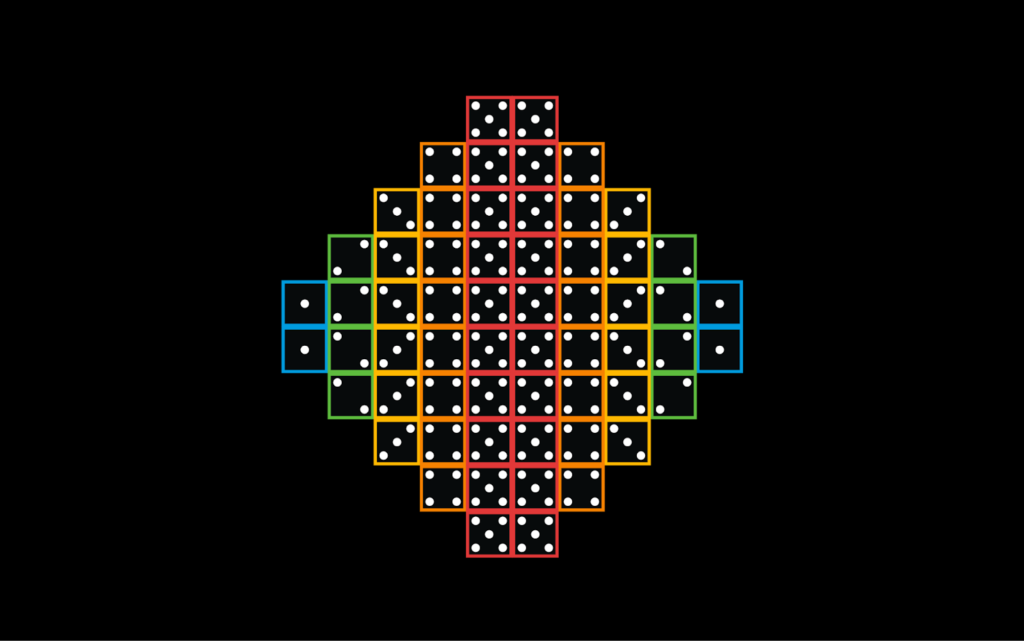
Kaleidoscopic Symmetry

Final Reflection
One of the most beautiful aspects of “How Many” is that it is deeply mathematical, while also nurturing skills that extend far beyond mathematics. Both teachers and students engage in counting, classifying, reasoning, and noticing structure, all while practicing curiosity, communication, and creative thinking.
Across classrooms, the activity helped students grow more comfortable sharing ideas, asking questions, and exploring multiple ways of seeing the same problem. At the same time, many teachers rediscovered the joy of doing mathematics alongside their students, often surprised by the questions that emerged and the directions the work could take. As students gained confidence in their thinking, classroom conversations became richer and more inclusive.
As we move into February with a focus on Number Sense and Fluency, we’re excited to continue designing experiences that honor both the mathematics itself and the broader habits of mind that support meaningful, joyful learning.