


When people ask what age groups Tile Farm Academy is designed for, they are often surprised by our answer: PreK to PhD. In fact, our entire team regularly plays, experiments, and makes new discoveries inside Tile Farm Academy.
To some, this may sound unusual, but it is entirely by design. When learning experiences genuinely appeal to people of all ages and abilities, they become naturally differentiated. Math can be frustrating at both ends of the spectrum: students who are struggling often feel left behind, while students who crave depth can feel bored or constrained. Every experience we design is intentionally low-floor, high-ceiling, allowing learners with different backgrounds, interests, and goals to engage meaningfully.
At the low end, Tile Farm Academy supports simple counting games, building puzzles, and visual explorations that invite young learners in. At the high end, the same tools are used for challenging puzzles, rigorous mathematical research projects, and even as a design environment for professional artists. This high ceiling is what makes Tile Farm especially powerful for enrichment and gifted learners who want to go further, ask deeper questions, and explore mathematics beyond standard curriculum boundaries.
When young learners are given tools with a genuinely high ceiling—along with the time, space, and respect to grow—they often do extraordinary things. Curiosity deepens, ideas compound, and playful exploration can evolve into serious mathematical thinking.
So how high is Tile Farm Academy’s ceiling? In this blog, we highlight three high-ceiling, wide-walls mathematical projects created by mathematicians and artists using Tile Farm’s products—examples that illustrate the depth these tools can support when curiosity is given time and space to mature.
A Combinatorics Research Project at Caltech
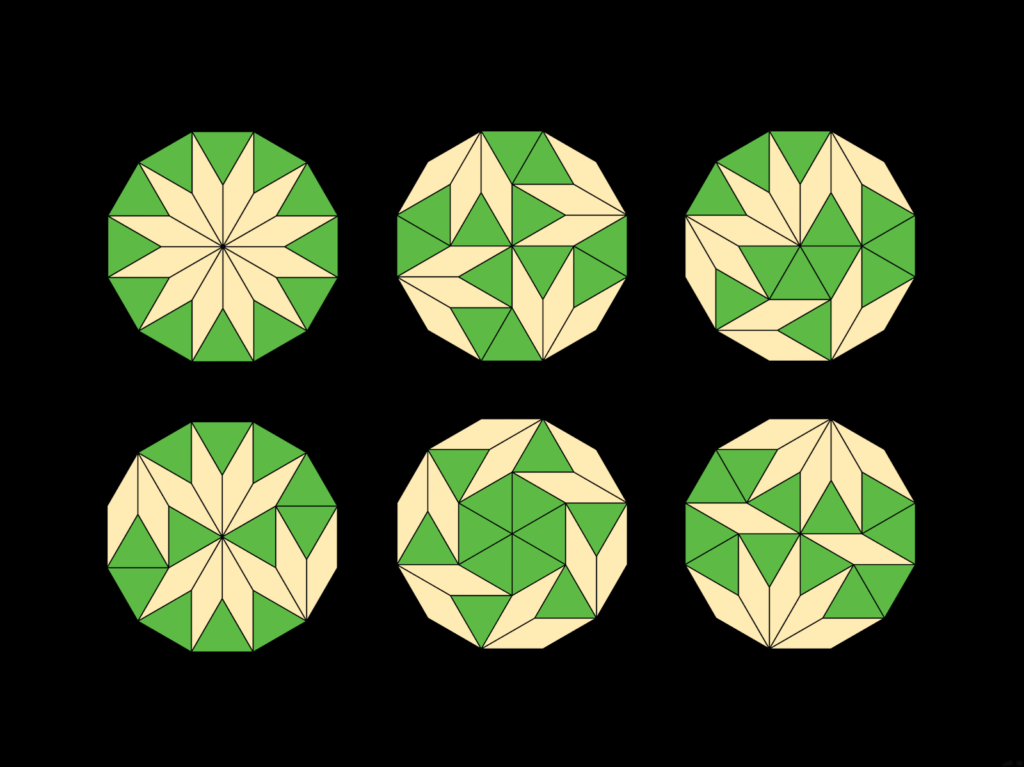
Jack Mattson, a student at Caltech, used Tile Farm as inspiration for a research project in combinatorics—the area of mathematics concerned with counting, organizing, and understanding complex patterns. His question was simple to state yet surprisingly deep: How many different ways are there to tile a regular dodecagon using just two basic shapes shown above?
Beginning with playful, visual explorations in Tile Farm Studio, Mattson developed a rigorous mathematical framework, ultimately identifying hundreds of distinct solutions and outlining directions for further research. What started as hands-on experimentation evolved into a formal investigation involving geometry, symmetry, and advanced mathematical techniques—an example of how an accessible tool can support authentic, college-level mathematical research.
A Conjecture Leading to Proofs of Conservation Laws for Tilings
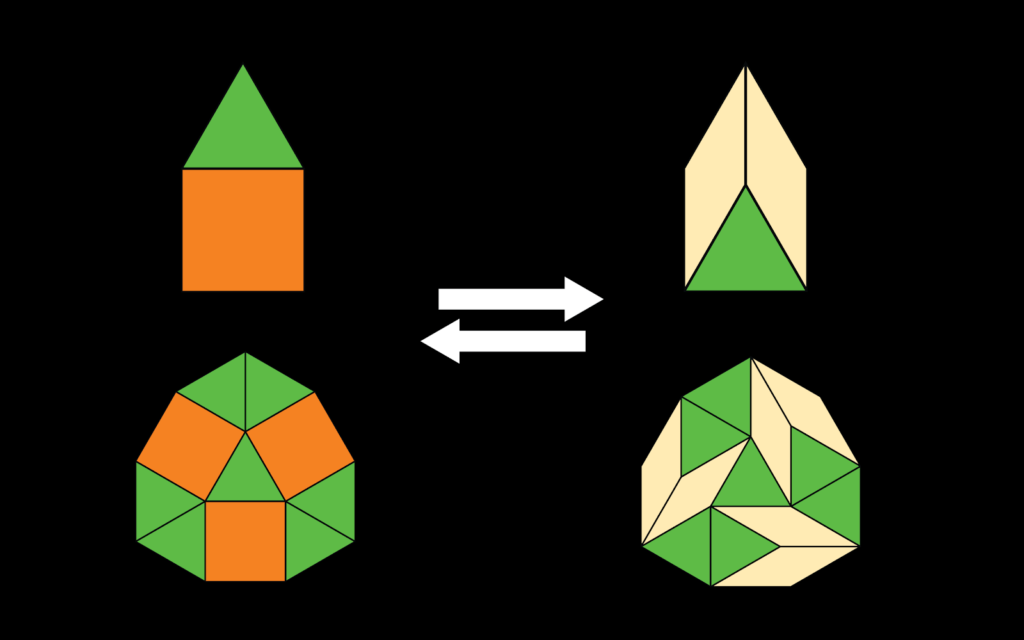
Louis Romero, a PhD mathematician and co-founder of Tile Farm, along with collaborator Tom Rona, developed a mathematical conjecture inspired by visual tiling patterns that was recently submitted to the American Mathematical Monthly. At the core of this project is a deceptively simple question: When a shape can be tiled in multiple ways using a limited set of pieces, what properties must remain unchanged?
This question led to what Romero and Rona call the flipping conjecture, which explores how one tiling can be transformed into another through small, local rearrangements of pentagons. From this playful, pattern-based idea emerged rigorous proofs of several conservation laws—mathematical rules showing that certain quantities remain invariant across all valid tilings of the same outline. The work highlights how hands-on visual exploration, like that encouraged in Tile Farm Studio, can lead naturally to publishable mathematics and deep theoretical insight.
A Deeply Mathematical Fashion Project
Alex Romero, co-founder of Tile Farm and an artist based in Los Angeles, CA, created a striking pair of shoes that bring advanced mathematical ideas into the world of wearable art. Designed and conceived in Tile Farm Studio through hours of experimentation and play, the shoes feature bold, colorful swirling patterns.
Beneath the surface, the design is grounded in rich mathematics. Mathematical concepts like fraction subtraction, infinite geometric series, and trigonometry were an inherent part of the design process. Above you’ll find a video highlighting the shoes and how they were designed in Tile Farm Studio.
Inspiring Great Minds
When students use tools with a truly high ceiling, they begin to see what is possible. Just as watching a virtuoso pianist or a world-class athlete can transform how we view a piano or a soccer ball, seeing deep mathematical work created with Tile Farm can reshape how students view themselves as mathematical thinkers.
How do younger students experience this high ceiling?
Every day, after completing Daily Digits, students unlock a new canvas in Harvest created by a professional mathematician or artist. This gives students daily access to the same ideas, patterns, and creative possibilities that drive deep mathematical thinking, and the inspiration to imagine themselves as part of that world.
Interested in using Tile Farm for high-ceiling, wide-walls enrichment?