

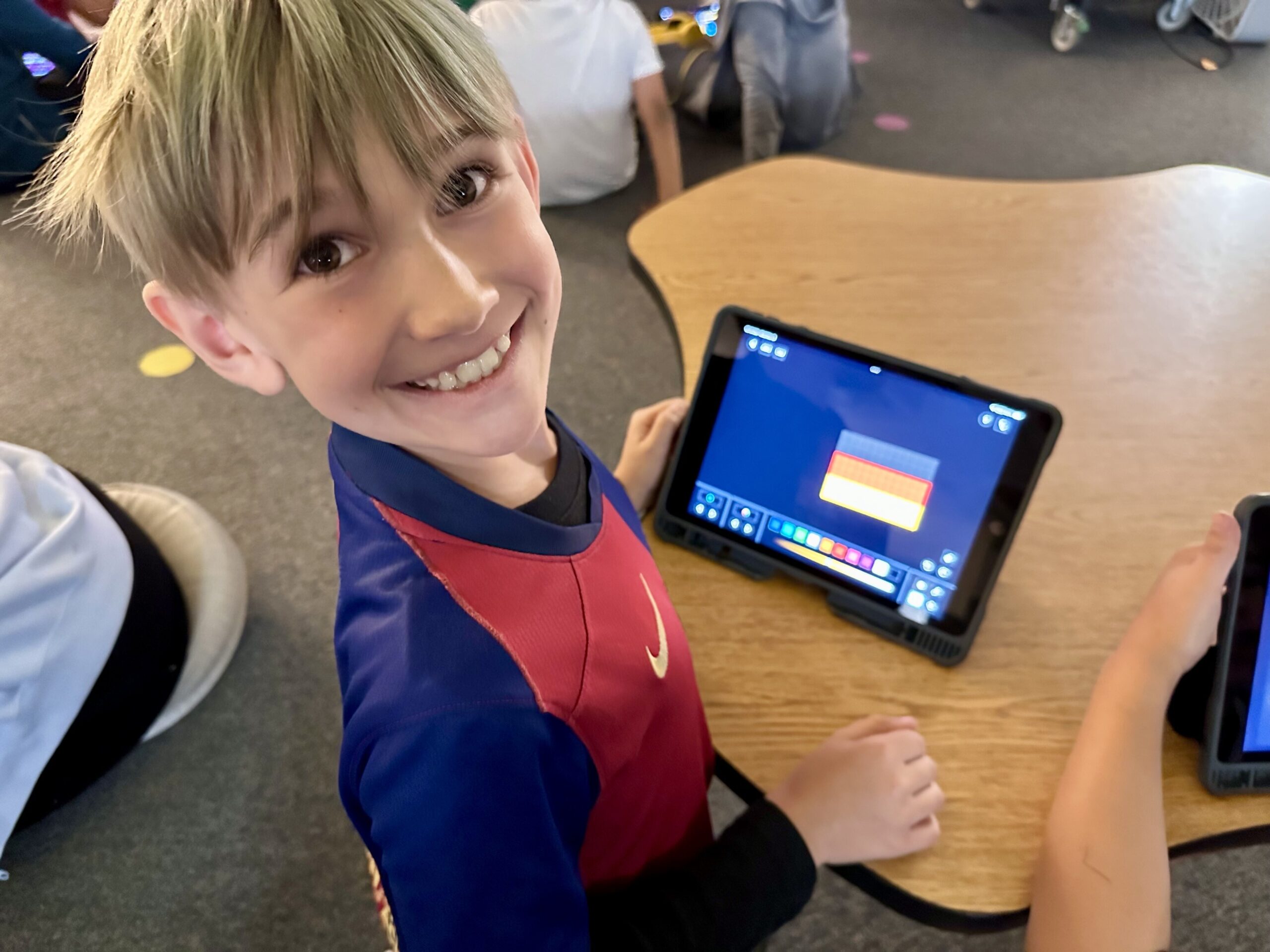
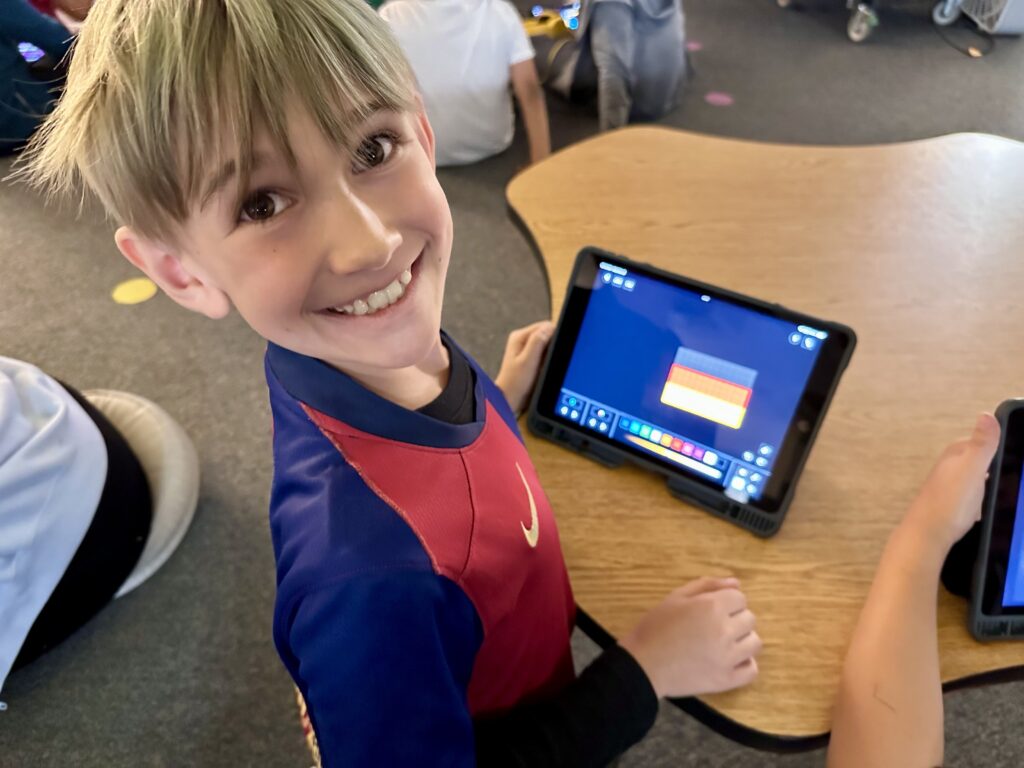
This week I visited a Title I elementary school in the Southwest where STEAM Lab teacher Ms. Bell invited me to work with her 4th- and 5th-grade classes and walk her through our new Tile Farm Academy dashboard. I do a lot of professional development across the state, but the culture in her lab stood out immediately— attentive, curious, and built around students taking ownership of their learning.
Even though she doesn’t teach a homeroom or math block, Ms. Bell clearly cares deeply about math proficiency, which is why she begins every class with Daily Digits — Tile Farm’s quick routine for math-fact fluency and number-sense puzzles. It’s become part of the rhythm in her room: finish your Daily Digits, then move into creative Studio time or Playground activities. It’s a simple routine, and students know exactly what to look forward to.
As she put it:
“My students have been using Tile Farm for over a year now, and they love it! It’s a great way to incorporate math, technology, and art. It’s highly engaging and a game my students actually ask for! The new Academy platform allows me to track their progress and see their growth as they improve their number sense and math knowledge while being creative and having fun. That’s a win-win.“
— Ms. Bell
Her classes were perfect examples of why I love visiting elementary schools and why I sometimes really miss being a teacher. As students completed their Daily Digits, they immediately started calling me over to see their favorite Studio designs from previous classes – tessellations, abstract mosaics, cultural symbols, and personal projects they were clearly very proud of. And these weren’t simple digital doodles; they were connections to art, culture, and science, as well as real understanding of symmetry, rotation, pattern building, and spatial reasoning.
And although it was inspiring to see their enthusiasm and sense of ownership, it was even more exciting to observe the students that were still finishing up their Daily Digits. A handful of students were working on a new variation of Engineer It puzzles together. They had been introduced to a new reflection mechanic and were quietly helping each other refine their solutions to match both the numeric and geometric goals. They weren’t following steps or explicit guidance — they were reasoning, adjusting, and explaining their thinking. Everything about their collaboration felt natural and they were willing to teach and learn from each other.
Once all the Daily Digits were complete, it was time for something new. So I introduced Ms. Bell and her students to Tile Talk, Tile Farm’s version of math talk— math discourse centered around discovery, play and problem-solving.
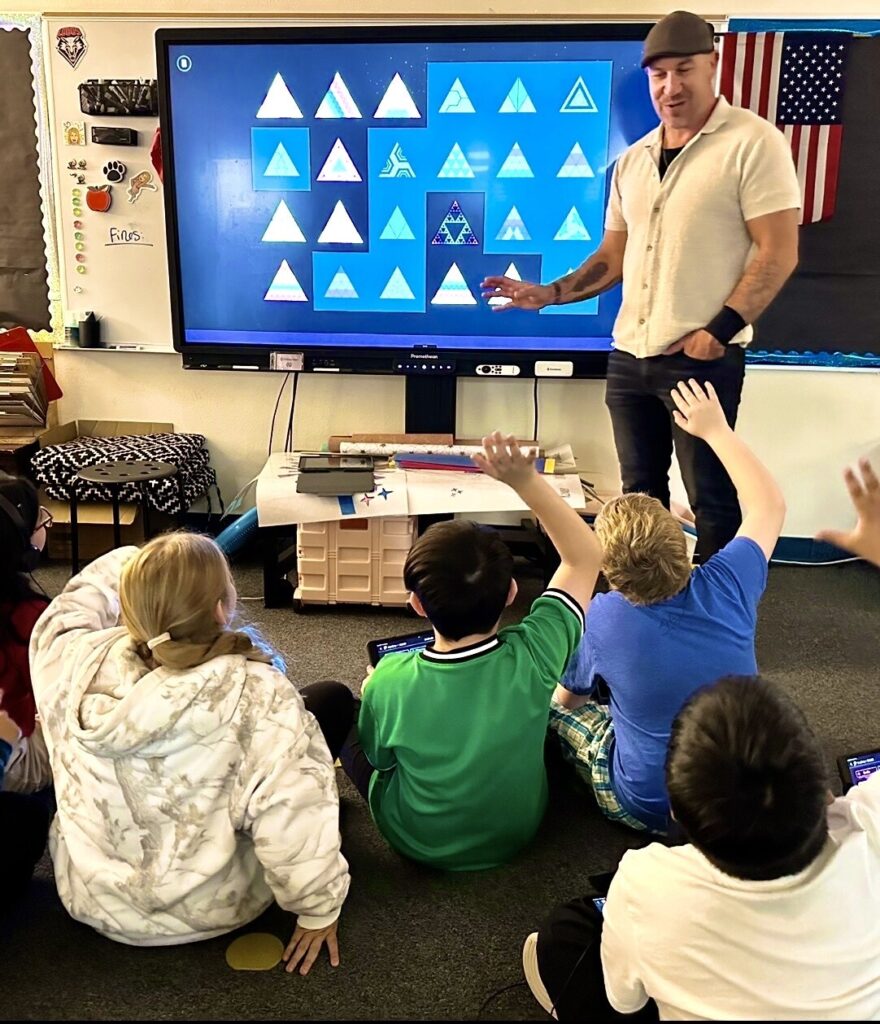
We started with a quick Crypto Tiles puzzle and decoded the phrase of the day, then played a few rounds of Last Tile Standing, our math-infused version of Guess Who?. Their questions were thoughtful and mathematically grounded— eliminating large groups of the 24 pattern options by asking about things like the fractions of colors, lines of symmetry, tile ratios, and shape classifications. The game did exactly what it was designed to do: give students a low-pressure way to practice academic vocabulary and mathematical reasoning while staying fully engaged as a group.
We were all a bit disappointed when the bell rang and cut our last round short, but as the students frantically shared their final designs and filed out of class, it was easy to reflect on what sets Tile Farm apart. We’re not hiding worksheets inside a video game. The learning is the gameplay. Every design choice, every challenge, every conversation students have with one another grows directly out of math.
I saw students who were confident, creative, and genuinely enjoying mathematics — a rare combination, especially in a small Title I school. And thanks to amazing teachers like Ms. Bell and transformative tools like Tile Farm Academy, now students everywhere have the chance to experience the joy and beauty of math.